
Lynwood Metal Gates designs and builds wrought iron gates in Lynwood, CA and the surrounding cities including Huntington Park, Maywood, Montebello, Hawthorne and Lawndale. Ornamental iron is not a decorative afterthought here: it is one of only three materials Lynwood’s code permits for a fence, which makes it the default rather than the upgrade.
That changes the design conversation. In most cities the discussion starts with material and colour, and here both are largely settled before anyone sits down — wrought iron, in black or white. What is left is proportion, and proportion is what separates a gate that suits its house from one that was ordered by size.
We have been drawing and fabricating ornamental gates for over twenty years, and almost everything that makes one look right is in the parts nobody names: how deep the top rail is against the pickets, whether the frame is visible from the street, how the leaf meets its pilaster, and where the eye is asked to stop.
Designing Within the Code
What the Material Rule Actually Leaves You
The code permits wrought iron, wood or PVC picket, or block, and fixes iron to black or white. Rather than a limitation, this is a fairly generous envelope: picket profile, top treatment, rail depth, panel division and infill density are all untouched by it. We use those to carry the character that a colour choice would carry somewhere else, and the result is usually more coherent than a gate assembled from finish options.
Spacing and Picket Dimensions
Open fence material is limited to 2 inches wide and no less than 4 inches apart. That fixes the rhythm of a picket gate more tightly than most owners realise, and it is the rule most often broken on gates bought off a rack. Working to it from the first drawing avoids a redesign, and it has the useful side effect of keeping the leaf light enough not to overwork its hinges.
Height Against the Front Yard Line
Within the front yard setback fences and walls are held to 48 inches, with 6 feet allowed behind that line in residential districts. A gate that steps up as it moves back from the street is usually how to get presence without breaching the front limit. An older Title 11 provision still prints 42 inches, so on a design sitting between the two figures we confirm the operative one before fabricating.
Style and Detail
Arched, Flat and Spear-Top Treatments
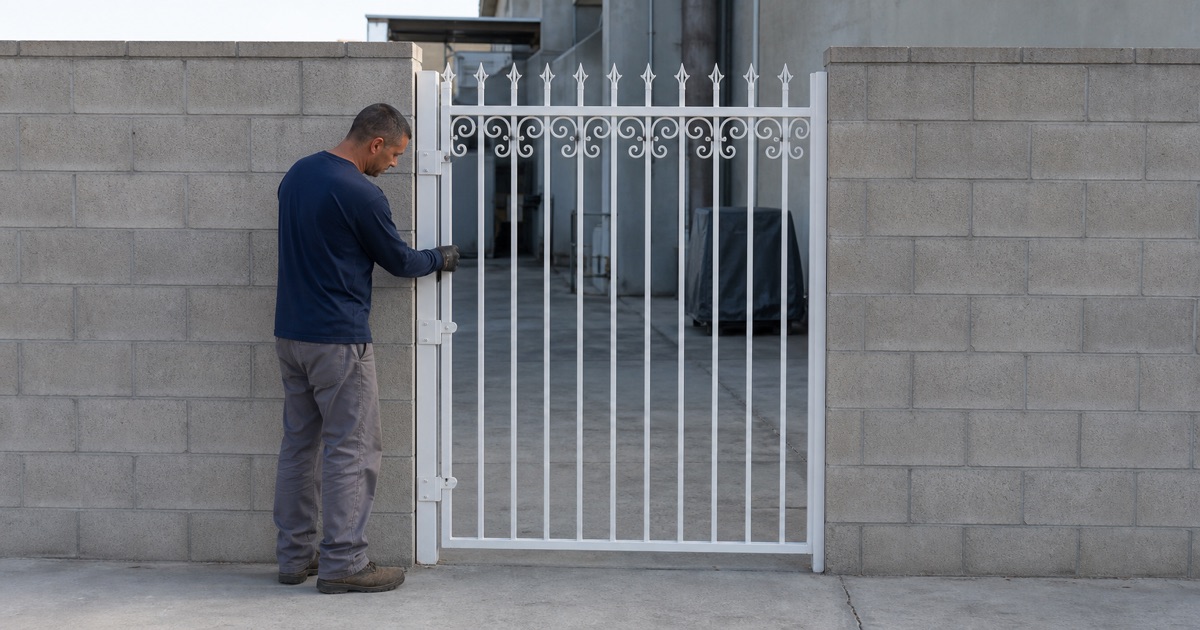
The top line is the first thing anyone reads from the street. An arched or radiused top suits stucco, a tile roof and a rounded entry and is set out from the actual opening rather than bent to a standard radius. A flat top with a deep rail suits a low horizontal frontage. Spear and finial tops add height and detail at the top of a picket without adding solid area, which keeps wind load down.
Scrollwork, Panels and Where to Stop
Ornament works best concentrated rather than spread. A single decorative band, a centre panel or a scrolled infill at the top third gives a gate a focus, where scroll applied evenly across the whole leaf reads as busy and costs considerably more to make. We draw the ornament against an elevation of the house rather than in isolation.
How the Gate Meets Its Pilaster
The junction between a leaf and its column is where a gate looks either built or bought. A leaf that stops short of the pilaster leaves a gap that undermines both the appearance and the security of the whole run. We set the hinge position and the leaf width so that the gate closes against something solid at both ends, with the gap consistent top to bottom.
Fabrication and Finish
Steel Sections and Joint Preparation
Gates are built from tube to ASTM A787, cut and welded in our own shop. Every load-bearing weld is dressed back and inspected before any coating goes near it, because a finished powder coat conceals the joint it is supposed to be protecting. That inspection is the reason coating happens after the weld check rather than as one continuous process.
The Coating Sequence
Zinc-rich primer goes onto welded joints, then TGIC polyester powder coating over the leaf. Where a gate sits in constant damp, hot-dip galvanizing to ASTM A123 goes underneath the powder. Done in that order the finish is protecting clean prepared steel, and a matte black or white topcoat has something durable beneath it rather than doing the whole job alone.
Hardware Sized to the Leaf
Hinges, latch and drop rod are sized from the calculated leaf weight rather than from the gate’s appearance. Ball-bearing hinges with grease fittings handle a moving load that would flog out a plain weld-on barrel within a couple of seasons. The sizing goes in the job file, so a repair years later begins from a number rather than an estimate.
- 20+ Years in the Trade
- Free On-Site Measure
- Permit Work Handled