
Lynwood Metal Gates fabricates custom gates in Lynwood, CA, drawn to the opening they will hang in and built in our own shop. Twenty years of doing this in one city means most of what we make is a response to a problem a stock gate could not solve: an opening that is not square, a slope that will not let a leaf swing, a frontage where the code has already decided the material.
Custom does not mean elaborate. Plenty of the gates we build are plain, and the reason they were made rather than bought is dimensional rather than decorative. An opening a few inches off a standard size is enough, because the alternative is packing a hinge and living with a leaf that is out of plumb from the day it goes up.
What fabrication actually buys you is control over the parts nobody sees: section sizes chosen for the span, hinge positions set for the calculated weight, and a drawing on file so a damaged member years later can be remade to match.
From Survey to Drawing
Measuring the Opening Properly
A survey takes widths at more than one height, the fall across the opening, the crown of the drive, and the position of every fixed thing a leaf could meet through its travel. Those figures go into a written measurement record that stays on file and is handed over with the finished gate. It is also what the design is drawn against, rather than a single width taken at the ground.
A Dimensioned Drawing Before Anything Is Cut
Nothing is fabricated until a drawing has been agreed showing leaf sizes, infill spacing, rail positions, hardware locations and how the gate meets its posts and pilasters. Moving a line on a drawing costs nothing. Moving a welded member in a finished frame costs a day and usually shows. The drawing doubles as the elevation the permit application requires.
Designing Inside the Code From the Start
Lynwood permits fences only in wrought iron in black or white, wood or PVC picket, or block, holds open infill to no more than 2 inches wide at no less than 4 inches apart, and caps the front yard at 48 inches with 6 feet behind the setback. Those constraints are applied at the drawing stage rather than discovered at inspection, which is the difference between a design decision and an expensive correction.
In the Shop
Cutting, Fitting and Welding
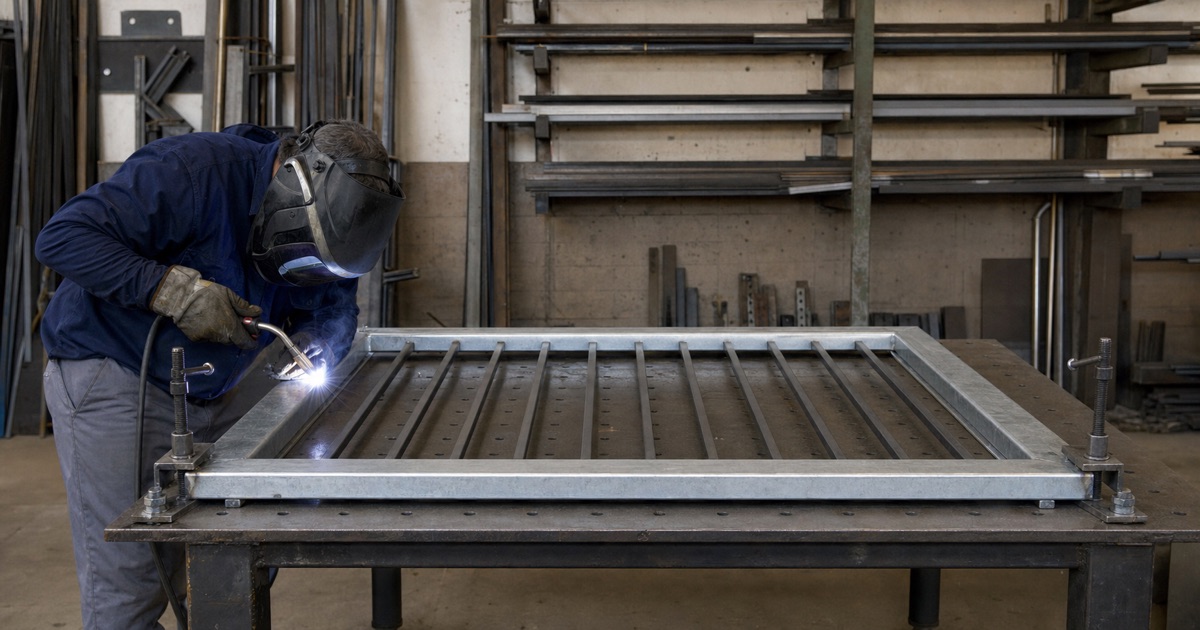
Gates are built from steel tube to ASTM A787, cut and fitted before anything is welded out, so the frame is square before it is permanent. Building it in our own shop rather than subcontracting the fabrication is what lets us hold the drawing, keep the offcuts and remake a part later without hunting a supplier who has changed their range.
Weld Preparation and Inspection
Every load-bearing weld is dressed back and inspected before any coating goes near it, because a finished powder coat looks the same over a sound joint and a poor one. A zinc-rich primer goes onto the joints before topcoat. That sequence is why the inspection happens at the bench rather than after the gate is finished and nothing can be seen.
Coating and Finish
TGIC polyester powder coating goes over the whole leaf, with hot-dip galvanizing to ASTM A123 underneath where a gate sits somewhere genuinely wet. Aluminium extrusion in 6005-T5 or 6061-T6 is an alternative where a gate will never be maintained and corrosion is the main risk, at the cost of denting more easily than steel.
Installation and Handover
Posts and Footings
Posts go 24 inches into base soil with a concrete base four inches larger than the post in every dimension, which is the standard the municipal code publishes, and heavier leaves get more than the minimum. Excavations are left open for inspection before the pour. A gate post carries the leaf as a rotating cantilevered load, which is a different problem from a fence post holding a panel.
Hardware Sized to the Calculated Weight
Hinges, latch and drop rod are sized from the finished material list rather than from the look of the gate, and ball-bearing hinges with grease fittings go on anything with real weight. The calculation is kept in the job file, so a repair in ten years starts from a number rather than an estimate made by whoever turns up.
Tested, Recorded, Handed Over
A gate is not finished when it is hung. Swing or travel is checked through the full arc or run, the latch is set, and where the gate is powered the operator force, travel limits and reversing behaviour are set, tested and written down. You are left with the drawing, the measurement record and the settings, which between them are what make the gate maintainable by anybody. That matters most when the person maintaining it is not us, which over a gate’s life is the likely case rather than the exception.
- 20+ Years in the Trade
- Free On-Site Measure
- Permit Work Handled