
Lynwood Metal Gates repairs gate openers across Lynwood, CA and the surrounding cities including Huntington Park, Maywood, Montebello, Hawthorne and Lawndale. Most of the calls we take describe a dead gate, and in most of those the operator itself is working perfectly and refusing to run for a reason it has no way of explaining.
That is by design. A modern operator supervises its own safety devices continuously, and when one reports a fault the correct behaviour is to stop. From the driveway that is indistinguishable from a burnt-out motor, which is why a large number of gate operators get replaced when the actual fault was a dirty lens or a knocked bracket.
So we diagnose from the outside in: supply, then safety circuit, then drive train, then the operator itself. It is the cheapest order for the customer and it is the order in which the faults actually occur.
Faults and What They Mean
Nothing Happens at All
A gate that does not respond to any input is a power or safety problem far more often than a mechanical one. We check the supply and the battery, then every monitored input in turn, because a single faulty photo eye will hold the whole system. Where a previous visitor has bypassed a safety device to make the gate run, we find that too, and it gets reinstated rather than left. A jumpered input is not a repair, it is a removed protection that will still be removed long after everyone has forgotten who did it.
The Motor Runs and the Leaf Stays Put
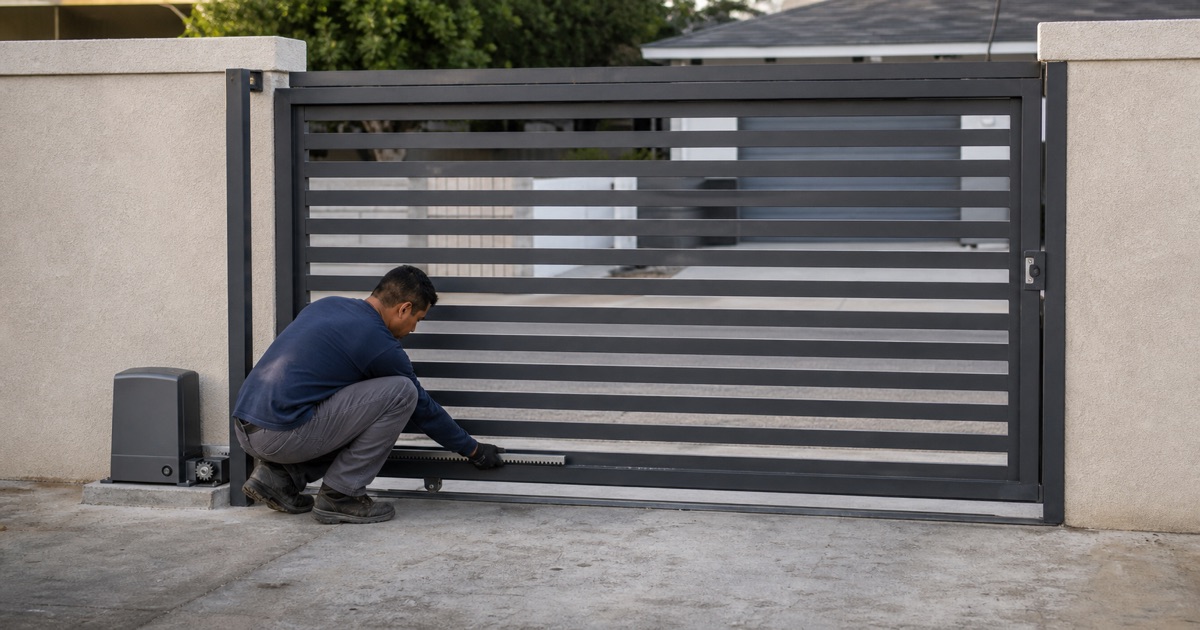
This is always a break between the drive and the gate. On a slide gate the candidates are a sheared key, a worn or misaligned gear rack, a slipped chain, or a manual release still disengaged from the last outage, while on a swing gate it is the arm linkage or the internal gearbox.
Occasionally the leaf itself is seized, and the operator is simply unable to overcome it. That is worth establishing before anything is replaced, because a new operator fitted to a gate that will not move by hand fails in exactly the same way as the old one.
Intermittent and Weather-Related Faults
The faults that come and go are usually water and alignment. Water tracks down conduit into terminals and into safety edge profiles, and a bracket that has been nudged will work in one light condition and not another. These are the hardest to catch on a single visit, so we test in the condition where the fault appears rather than assuming it will present on demand.
Remotes, Keypads and Receivers
A remote that works intermittently is usually the receiver, its aerial, or interference rather than the transmitter. Keypads more often fail where the wiring enters, because water runs down inside the conduit and sits on the terminals. Pairing a new remote to a failing receiver appears to fix it for a week, which is why we test the receiving end first.
Servicing and Settings
Force, Limits and Reversing
Every repair ends with travel limits, closing force and reversing behaviour set and tested against an obstruction rather than left wherever the fault pushed them. Those settings are written down at handover. A record of the numbers from when the gate was working correctly is the single most useful diagnostic the next technician will have.
Safety Devices Tested, Never Bypassed
Entrapment protection gets tested as part of the work, not disconnected to make a gate run. Bypassing a photo eye is the most common thing we find already done when we arrive, and it removes exactly the protection the standard exists to provide. Where a device keeps faulting, the cause is fixed rather than the device removed.
Duty, Cycles and Repeat Failures
An operator that fails at a predictable interval is telling you it was specified for a different gate. UL 325 sorts operators into Class I through Class IV by where they are used, and a community entrance running two hundred cycles a day will consume a unit chosen for a household driveway no matter how well it is maintained. We count the real cycles before recommending another replacement of the same part.
Battery, Solar and Power Backup
Battery backup is the part nobody notices until an outage, by which point the cells have often been flat for a year. On a solar operator the same problem presents seasonally: a gate that works all summer and stops in December has an array sized to the average rather than to the winter case. We test the battery under load rather than reading a voltage off it at rest. A tired cell reads close to normal until current is drawn from it, which is why a gate can pass a visual check in the morning and fail at the first outage that evening.
- 20+ Years in the Trade
- Free On-Site Measure
- Permit Work Handled