
Lynwood Metal Gates builds and installs commercial security gates in Lynwood, CA and the surrounding cities including Huntington Park, Maywood, Montebello, Hawthorne and Lawndale. The industrial and commercial frontage along Long Beach Boulevard and Atlantic Avenue is a large part of our work, and after twenty years we know which of these gates fail from wear and which fail because they were never specified for the duty they carry.
A commercial gate is a production item. When a household gate fails it is an inconvenience; when a yard gate fails, vehicles stop moving and a site is left open overnight. That changes what matters in the specification: duty rating, serviceability, and how quickly a common wear part can be replaced all outrank appearance.
It also changes who decides. On commercial work the requirement often comes from a code provision, an insurer or a lease rather than from preference, so the first question we ask is what obligation the gate is there to satisfy.
Yard and Perimeter Gates
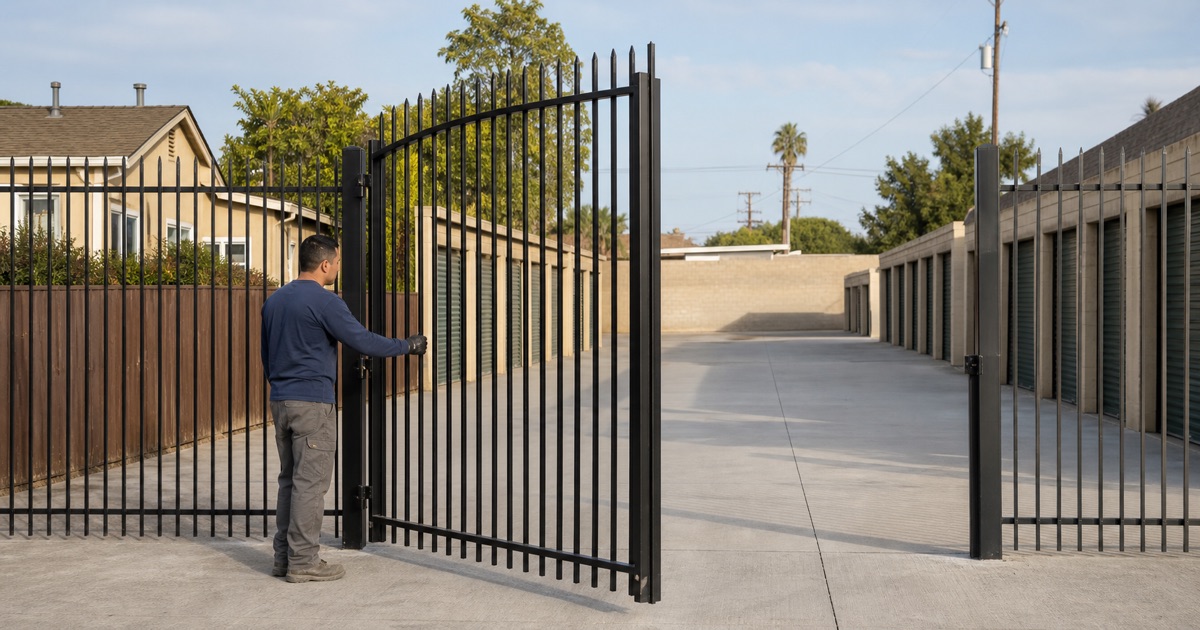
Cantilever Slide Gates for Vehicle Yards
On a working yard the gate has to open in weather, over a surface that trailers have chewed up, dozens of times a day. A cantilever gate suits that because nothing runs on the ground: the leaf is carried on truck assemblies in semi-enclosed track set behind the opening. We size the counterbalance from the leaf and check the available backrun before proposing one, because a cantilever squeezed into insufficient space is a gate that will sag at the free end.
Perimeter Runs and the Gate That Interrupts Them
A perimeter is only as good as its weakest opening, and that is almost always the gate. The frame has to be stiffer than the fence either side of it, the gap at the closing edge has to be small enough that it cannot be levered, and the drop rod or lock has to engage something set in concrete rather than a surface fixing. We detail the closure as carefully as the leaf, because that is where a perimeter is actually defeated. On a double-leaf yard gate that means a drop rod into a sleeve set in concrete rather than a surface plate, and a meeting stile detailed so the two leaves overlap instead of butting.
Crash-Rated and Anti-Ram Barriers
Stopping a vehicle is a structural problem, not a security one. A crash-rated barrier is designed and tested against a stated vehicle mass and speed, and its foundation is usually a larger job than the barrier itself. Most sites do not need this. Where one genuinely does, the rating has to follow an assessment of the real threat rather than being chosen because it looks substantial.
Storefront and Building Security
Scissor and Side-Folding Gates
A scissor or side-folding gate closes a glazed shopfront after hours and folds back clear of it during trading, which is why it suits a frontage where a solid shutter would kill the display. The design question is where the stack sits when the gate is open, because a stack that covers a third of the window has solved one problem and created another. We survey the reveal before specifying. Where the stack has nowhere to go, a side-folding gate that parks against a return wall or a roll-up unit in the head are usually better answers than forcing a scissor gate into a frontage it does not fit.
Rolling Steel Security Doors
A roll-up rolling steel door closes a service opening, a loading bay or a whole shopfront outright, and it is the right answer where nothing needs to be seen through the opening. Head clearance is the constraint: the barrel and its housing need real room above the opening, and retrofitting one into a finished frontage is where the cost hides. We check the head and the guide runs first. The other thing worth settling early is whether the door needs to be operated from inside, outside or both, because adding a second control position afterwards means running cable through a finished opening.
Electric Locking and Closers
Where a gate has to fail secure or fail safe in a defined way, electromagnetic gate locks and hydraulic gate closers do the work that a latch cannot. Which way it should fail is a decision with real consequences in a fire, so it is made deliberately and recorded rather than inherited from whatever was fitted before.
Gates the Code Requires
Eight-Foot Ornamental Iron on Self-Storage
Where personal storage abuts residential use, Lynwood requires an eight-foot ornamental iron fence, and separately prohibits rolled razor wire on those sites. That combination rules out most of the cheap perimeter options and pushes the job toward fabricated iron. We build the gate leaf to match the run either side so the entrance does not read as an afterthought. At eight feet the leaf is heavy enough that hinge and post sizing stop being a formality, and a sliding arrangement is often more practical than a swing pair on a storage frontage with vehicles queuing.
Solid, Sight-Obscuring Enclosure Gates
Auto repair, used car sales, car washes and tire and upholstery uses must provide a trash enclosure with solid block on three sides and a solid, sight-obscuring gate. Because the code specifies opacity rather than height, an open infill will not pass. These gates get hit by bins daily, so we use a heavier frame and hinges sized well above the leaf weight.
Securing Registered Vacant Property
Lynwood’s foreclosure ordinance makes a breached gate a violation in itself and defines securing to include repairing fences and chaining or padlocking gates, with weekly inspections required of out-of-area owners and each day of non-compliance a separate offence. We do the repair and securing work that keeps a registered property compliant, and we work to the timescale the ordinance actually imposes.
Access, Duty and Emergency Provision
Sizing for the Real Cycle Count
UL 325 sorts operators from Class I through Class IV by where the gate is used, and a commercial entrance usually sits in Class III or IV. The number that matters is cycles per day, not the size of the gate. An operator chosen on leaf weight alone but run at four times its intended duty will fail early, and it will keep failing until the specification is corrected.
Emergency Access Designed In
A Knox box or fire department key switch gives crews entry without cutting the gate, and the California Fire Code sets the access dimensions behind it. Adding this at design stage costs almost nothing. Adding it after a plan check has failed means reworking an installed gate and its controls.
Serviceability as a Specification Item
We specify commercial gates around parts that can be obtained and changed quickly, because on a site where the gate is production equipment, availability beats marginal performance. Operators from LiftMaster, DoorKing, HySecurity and FAAC are chosen partly for that reason, and the settings are written down at handover so the next technician is not starting from nothing.
- 20+ Years in the Trade
- Free On-Site Measure
- Permit Work Handled