
Lynwood Metal Gates designs and installs driveway gates in Lynwood, CA and across the surrounding cities including Huntington Park, Maywood, Montebello, Hawthorne and Lawndale. Twenty years of building leaves for driveways in this part of the county means we know which openings take a swing gate, which need a slide, and which have a slope problem nobody mentioned.
A driveway gate is the only part of a house that has to be structural, decorative and mechanical at once. It has to look right from the street, carry its own weight cantilevered off two hinges for decades, and either clear a moving car or stop one. Most of the driveway gates we are called to replace failed on the second of those three while looking perfectly good.
That is why the measure comes before the drawing. We take the clear width, the fall across the opening, the crown of the drive, the available run alongside it and the position of anything the leaf could catch, then design to those numbers rather than adapting a standard size.
Swing, Slide or Cantilever
Swing Gates and the Arc They Need
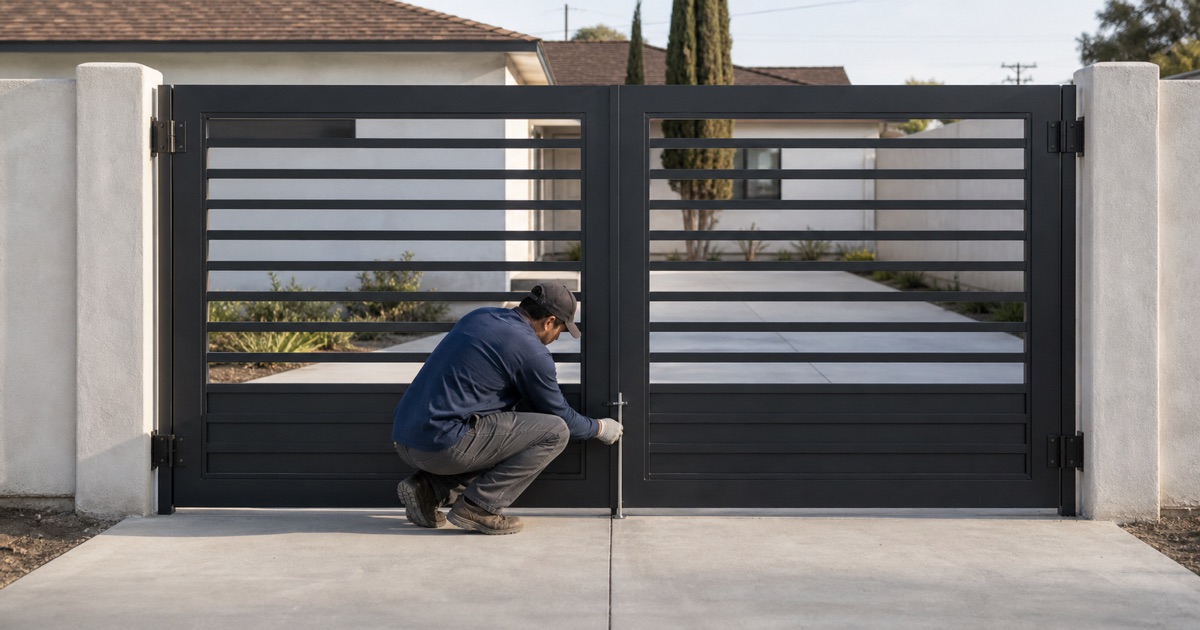
A swing gate is the simplest mechanism and the most sensitive to ground. The leaf sweeps a quarter circle, and anything inside that arc that is higher at one end than the other will stop it: a resurfaced drive, a raised planting bed, a settled apron at the street. Single leaves suit narrow openings, and a pair splits the weight and halves the arc on wider ones, which is usually the better answer past about twelve feet. The other advantage of a pair is that each leaf is half the cantilevered load on its hinges, which shows up as a gate that stays square for years longer.
Ground-Running Slide Gates
A slide gate runs on V-track set into the drive, with guide rollers holding it upright and non-pinch rollers where fingers could reach. It needs backrun roughly equal to the opening, and it does not care about slope across the arc because there is no arc. What it does care about is debris, since anything that collects in the track becomes the thing the leaf climbs. On a drive that catches leaf litter or windblown grit, that means either a regular sweep of the track or moving to a cantilever arrangement that has no track to fill.
Cantilever Gates Where the Ground Is Poor
A cantilever gate carries its weight on truck assemblies set behind the opening and never touches the ground as it travels, which makes it the right answer on an uneven drive, a yard that floods, or an entrance that has to stay usable when the surface is churned. The trade is space: the counterbalance tail needs meaningful room behind the opening, typically about half the clear width again. That tail is also a fixed obstruction along the fence line when the gate is open, so it has to be planned around rather than discovered once the gate is running.
Material and Finish
Ornamental Iron in Black or White
Wrought iron is one of only three materials Lynwood’s code permits, and the code fixes the colour to black or white. Because the finish decision is made for you, the character of the gate has to come from proportion and detail instead: picket spacing, the depth of the top rail, whether the top is flat, arched or spear-finished, and how the frame meets the pilaster.
Aluminium Where Steel Would Rust
Aluminium extrusion in 6005-T5 or 6061-T6 does not corrode, which makes it a sound choice where irrigation throws onto the gate daily or where nobody will maintain a coating. It is also lighter for the same span, so hinges and operators work less. It dents where steel would resist, so we keep it away from openings that see regular vehicle contact.
Steel Sections and How They Are Coated
Steel gates are built from tube to ASTM A787 and protected in sequence rather than in one go: welds dressed back, zinc-rich primer onto the joints, then TGIC polyester powder coating over the whole leaf. Hot-dip galvanizing to ASTM A123 goes under the coating where a gate sits somewhere genuinely wet. The order matters because a coating applied over scale or an undressed weld is protecting nothing. A finished powder coat looks identical either way, which is precisely why the inspection happens before the coating rather than after it.
Designing for a Lynwood Frontage
Height Against the Setback Line
The front yard setback is where most driveway gate designs run into the code, because 48 inches is lower than people expect and hedges are held lower still at 36 inches. Behind that line residential property gets 6 feet. A gate that steps up as it moves back from the street is often the way to get the presence someone wants without breaching the front limit.
Infill Dimensions the Code Sets
Open fence material may be no more than 2 inches wide and spaced no less than 4 inches apart. That is a tighter constraint on the look of a picket or slat gate than most people realise, and it is the rule most often missed when a gate is bought rather than built. Designing to it from the start also keeps the leaf lighter, which helps the hinges and the operator.
Sight Lines at the Corner
Lynwood defines a clear corner area by construction rather than by height, measuring 10 feet back at driveways and 30 feet at streets from the intersection of the right-of-way lines, with nothing permitted to obstruct visibility as judged by the city engineer. Because no height figure is given, a gate near a corner is a judgement call, and the engineer can require a larger area on a difficult junction.
What We Settle Before Fabrication
The Opening, Measured Properly
Widths at three heights, fall across the opening, crown of the drive, and the position of every fixed thing the leaf could meet. Those go into a written measurement record that is kept on file and handed over with the gate, so a repair years later starts from what was actually built.
The Permits, Both of Them
Lynwood issues planning approval and the building permit separately, and the fence permit application asks for a notarized letter from all abutting landowners consenting to the location, or a licensed engineer’s survey in its place. We establish which route is realistic early, because it sits on the critical path for the whole job.
The Weight, Before the Operator
Leaf weight is calculated from the finished material list, not estimated from the opening width. That number decides the hinge size, the post section, the footing and, if the gate is powered, the operator class. Getting it after the gate is built is how a driveway ends up with a motor working at the top of its duty rating.
- 20+ Years in the Trade
- Free On-Site Measure
- Permit Work Handled