
Lynwood Metal Gates builds sliding and cantilever gates for Lynwood, CA driveways, yards and industrial frontages. These are the gates we specify when a swing leaf will not work, and after twenty years the reasons are usually the same three: there is no arc to swing through, the ground will not stay level across one, or the opening is simply too wide for a leaf hung on hinges.
A sliding gate solves a geometry problem and introduces a mechanical one. Instead of two hinges carrying a static load, there is a leaf on wheels or trucks travelling several metres, several times a day, past guides that have to keep it upright. Everything about how well it lasts comes down to that running gear and to how true the leaf is running.
So the survey looks at different things from a swing gate survey: the available run alongside the opening, what the surface is made of and where it drains, and how much room exists behind the gate for a counterbalance tail.
Ground-Running Slide Gates
Track, Rollers and Guides
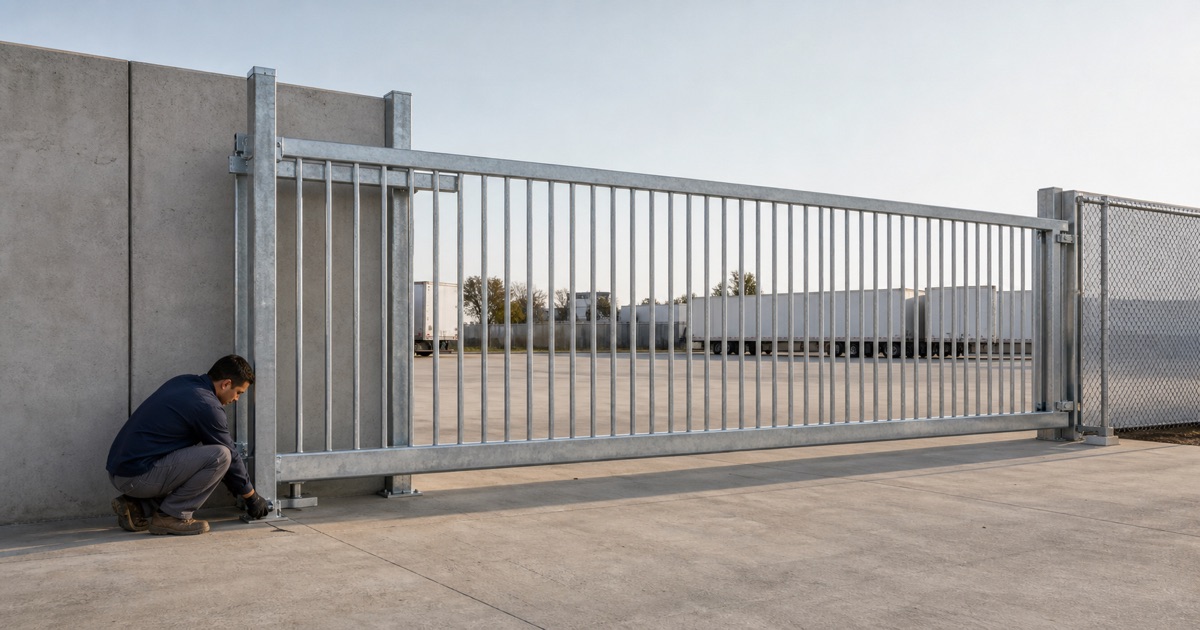
A tracked slide gate rolls on V-track set into the drive, held upright by guide rollers at the post and fitted with non-pinch rollers where fingers could reach a moving edge. The design is simple and comparatively inexpensive, and the whole system depends on the track staying clear. Grit, leaf litter and windblown debris are what actually end these gates, because anything sitting in the track becomes the thing the leaf climbs.
Where a Tracked Gate Is the Right Answer
On a clean, well-drained surface with room alongside the opening, a ground-running slide is the most efficient way to close a wide gap. It needs backrun roughly equal to the clear opening, and it does not care about a slope across the arc because there is no arc. On a domestic driveway with a paved apron it will run for years with an occasional sweep of the track.
Cantilever Gates
How the Load Is Carried
A cantilever gate hangs from truck assemblies running inside semi-enclosed track, with everything mounted behind the opening on posts set in concrete. The leaf projects across the gap carrying its own weight, which is why the counterbalance tail behind the gate has to be a real proportion of the span. Nothing touches the ground at any point in the travel.
Why That Matters on a Working Yard
A yard surface takes a beating from trailers and loaders, holds water where it has settled, and collects material nobody intends to leave there. A tracked gate in that environment fails constantly. A cantilever ignores all of it, which is why it is the standard answer for truck and trailer yards, container storage, dismantlers and any site where the entrance has to keep working in poor conditions.
Sizing Trucks, Posts and Sections
As the span grows the frame has to get deeper to stay rigid, and that added weight passes into the trucks, the posts and the footings. We size the section from the actual span rather than scaling a standard design, and we set the truck spacing so the leaf is supported through its whole travel instead of dipping as it passes the last support. Footings for cantilever posts carry a moment rather than a simple vertical load, so they are dug and reinforced accordingly.
Automation and Maintenance
Driving a Sliding Leaf
Slide operators drive the gate through a gear rack fixed along the frame or through a chain, with the pinion on the operator. Alignment is the whole story. A rack on a leaf that is not running true wears through its teeth in a fraction of its expected life and destroys the pinion with it, so we get the gate running correctly by hand before any operator is fitted.
Safety on a Moving Leaf
A sliding gate creates a shear point wherever the leaf passes a fixed object, which is why ASTM F2200 sets requirements for guarding the roller path and controlling gaps, and why UL 325 requires monitored external entrapment protection. Photo eyes cover the opening and safety edges cover contact with the leaf, while a safety loop holds the gate for a vehicle. The loop does not substitute for the photo eye, because it cannot see a person.
What Wears and When
Rollers, guide rollers and truck bearings are the consumables, and they give warning before they fail: a change in running noise, a leaf that dips at one point in its travel, or an operator working visibly harder. Catching it there is a part. Ignoring it until the operator force is increased to compensate is how a worn bearing becomes a bent frame member. On a commercial entrance we would rather see the gate twice a year than once, after the leaf has been dragged into a shape it cannot be pulled back out of.
- 20+ Years in the Trade
- Free On-Site Measure
- Permit Work Handled