
Lynwood Metal Gates handles gate repair across Lynwood, CA and the surrounding cities including Huntington Park, Maywood, Montebello, Hawthorne and Lawndale, with more than twenty years of fabricating and hanging the gates we now get called to fix. That matters on a repair more than on an installation, because the person who has built a few hundred leaves recognises what a failing one is doing.
Most gate faults are misdiagnosed as the wrong component. A gate that will not move gets blamed on the operator, when the operator is refusing to run because a safety device is reporting a fault. A leaf that drags gets a hinge adjustment, when the post it hangs from has rotated in a footing that was never deep enough. Adjusting around the symptom buys a few months and usually makes the underlying failure worse.
So we diagnose before we quote. Every call starts with the gate under power where it is safe to run it, the leaf weighed or calculated, and the post and footing checked, because those three numbers decide whether a repair will hold.
Common Faults and What Actually Causes Them
The Leaf That Sags Toward the Latch
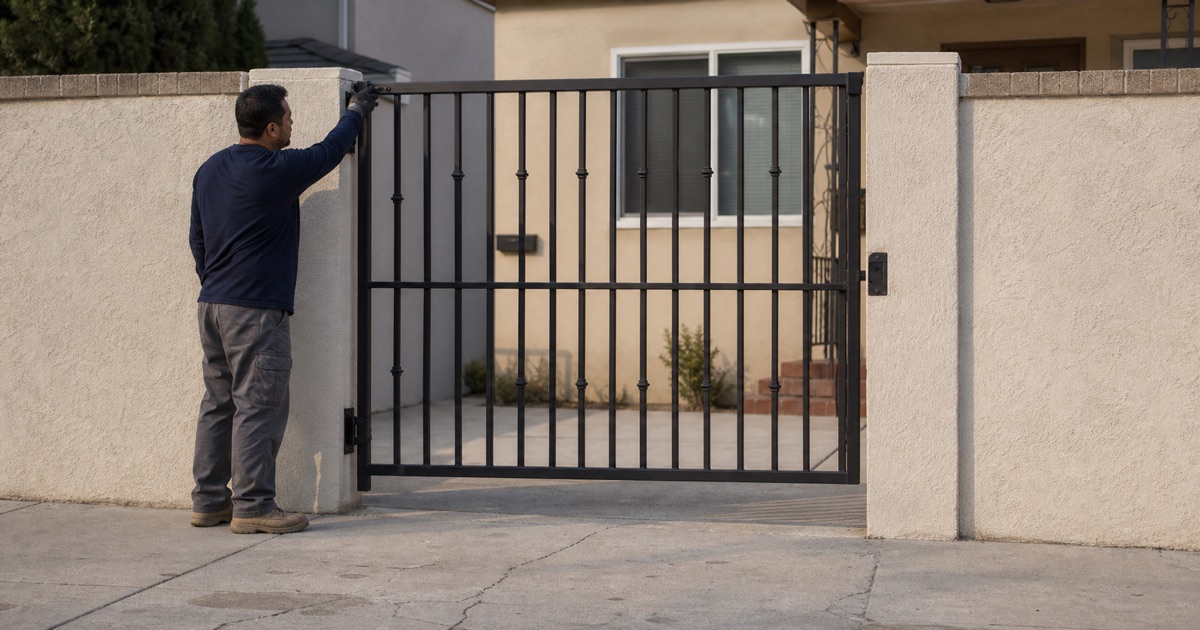
A swing leaf drops at the latch corner when the hinge geometry has failed, and there are only three real causes: hinges undersized for the leaf weight from the start, hinge fixings tearing out of a post, or a post rotating in soft ground. Ball-bearing hinges with grease fittings carry a moving load far better than a plain weld-on barrel, and sizing them means knowing the weight rather than guessing from the width. The tell for which of the three it is comes from where the gap opens: a hinge problem shows an even droop at the latch, a fixing problem shows the top hinge pulling proud of the post, and a footing problem tilts the whole post so the gap runs wider at the top than the bottom.
Track, Rollers and Cantilever Trucks
Ground-running slide gates fail at the interface with the ground. Grit packs the V-track, guide rollers seize, and non-pinch rollers wear flats that make the leaf lurch. Cantilever gates avoid the ground entirely but move the wear into the truck assemblies and the semi-enclosed track, where a worn bearing shows up as a leaf that dips as it passes the last support. None of this is improved by increasing the operator force, which is the usual first response and the reason a worn roller so often ends up as a stripped gear rack or a bent frame member.
Corrosion at the Bottom Rail
Ornamental iron corrodes from the bottom up, because water sits in the bottom rail and at the foot of each picket. Caught early this is a repair rather than a replacement: the affected section is cut out, new material let in, the joint primed with a zinc-rich primer and the leaf recoated. Left long enough the section loses wall thickness and the frame starts to rack.
Residential Gate Repair
Driveway Gates on Older Lynwood Frontages
A lot of the residential gates here were fitted to a house that has since had its driveway resurfaced, which raises the level under the arc of a swing leaf and makes a gate that used to clear now catch. The fix is rarely the gate. We check the travel across the whole arc and correct the geometry, rather than trimming the bottom rail and leaving a gap that defeats the point of the gate.
Pedestrian and Side-Yard Gates
Smaller gates fail at the latch and at the hinge fixings, because they get used many times a day and are usually the lightest-built thing on the property. Lynwood requires any fence or wall to include a gate or opening no less than 30 inches wide for access to the structures behind it, so a side gate that has been screwed shut because it stopped latching is not an acceptable long-term answer.
Pool Gates That No Longer Latch
A pool gate that does not self-close and self-latch is a safety failure rather than a maintenance item. Lynwood has adopted the 2021 International Swimming Pool and Spa Code with its own amendments, which require access gates to open away from the pool and to carry a self-latching device no lower than 60 inches above the ground, with the enclosure at least 60 inches high. We repair to that standard rather than to whatever was there before.
Commercial and Industrial Gate Repair
Yard and Cantilever Gates
On a working yard the gate is a production item, and a failure stops vehicles rather than inconveniencing a household. We carry the common wear parts for cantilever trucks, rollers and chain drive, so a routine failure does not wait on an order. Yard gates also take loads nobody designed for, from forklifts nudging them to trailers catching a trailing edge, and that damage concentrates at the frame corners where it is least visible.
Gates Hit by a Vehicle
Vehicle impact is the most common single cause of commercial gate damage, and the question is always whether the frame can be straightened and reinforced or whether the damaged bay should be cut out and rebuilt. Straightening a member that has yielded leaves it weaker than it looks, so on a leaf that carries an operator we usually replace the section rather than pull it back. Where the impact has moved the post, the footing is checked before anything is done to the gate.
Community and Apartment Entrances
A shared entrance cycles more in a month than a driveway gate does in a year, so components that are fine on a house are consumables here. Recurring faults on these are usually a duty-rating mismatch rather than bad luck. We look at the cycle count against the operator’s UL 325 class before replacing the same part a third time.
Shopfront Scissor and Rolling Steel
Scissor and side-folding security gates jam when a bottom guide fills with debris or a pivot dries out, and rolling steel doors fail at the spring and the bottom bar. Both are usually repairable in place. The exception is a curtain that has been forced, where the slats have deformed and a repair will never run smoothly again.
How a Repair Runs
We Run the Gate Before Touching It
Where it is safe, the gate is operated and watched through a full cycle. Most faults announce themselves in that first cycle, and a gate that has already been dismantled by someone else has thrown away the best diagnostic information available.
The Cause Gets Named, Not Just the Symptom
We tell you which component failed and what made it fail. Those are different things, and a repair that fixes only the first is a repair you will pay for again.
Safety Devices Are Tested, Not Bypassed
Any work on a powered gate ends with the entrapment protection tested rather than disconnected. Bypassing a photo eye to make a gate run is the single most common thing we find already done when we arrive, and it removes the protection the standard exists to provide.
Force and Limits Are Reset and Written Down
Operator force, travel limits and reversing behaviour are set, tested and recorded at handover rather than left wherever the fault pushed them. That record is what tells the next technician whether the settings have drifted.
- 20+ Years in the Trade
- Free On-Site Measure
- Permit Work Handled