
Lynwood Metal Gates builds and repairs pool safety gates in Lynwood, CA. This is the one gate on a property where the specification is not a matter of preference and where getting a detail wrong has consequences that have nothing to do with appearance or cost.
It is also the gate most often found non-compliant, usually because it was compliant once. Closers weaken, latches get moved down to a height children can reach because adults found the correct height awkward, and a gap opens at a hinge edge as a post settles. None of that is visible from the house.
Lynwood adds a complication of its own: it carries two pool provisions, an older set of rules in Title 11 and a newer adoption of the 2021 International Swimming Pool and Spa Code with city amendments. They do not agree on every figure. We build to the newer and more restrictive standard, and we tell you where the two differ rather than quoting whichever suits.
What the Adopted Code Requires
Gates That Open Away From the Water
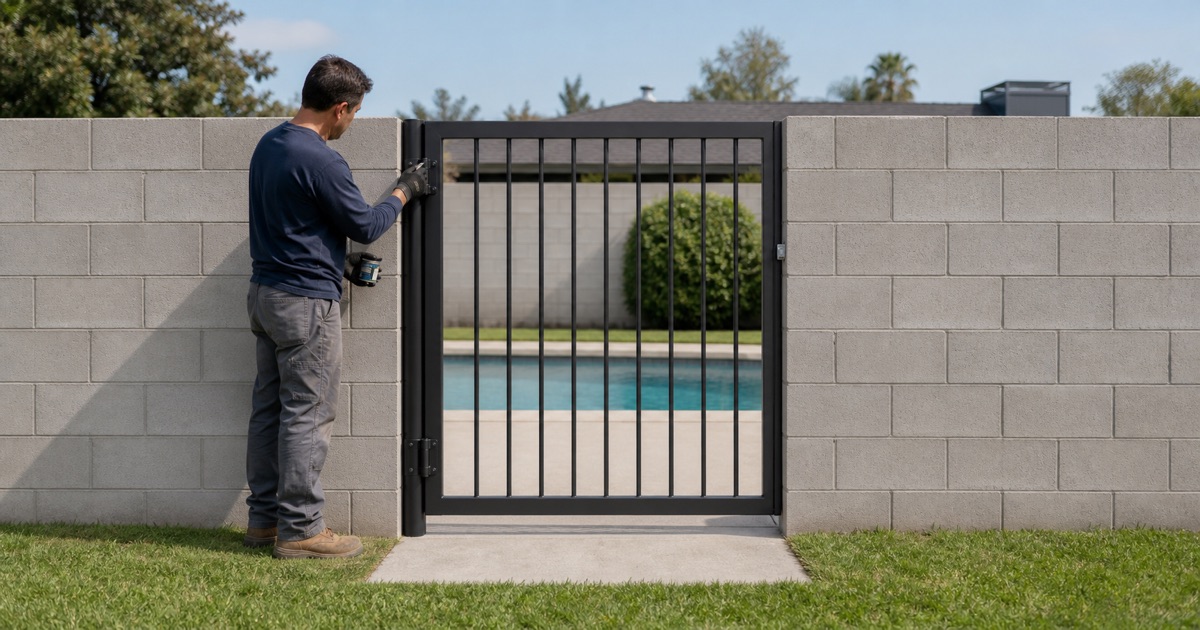
The enclosure characteristics Lynwood has adopted require any access gate through the barrier to open away from the swimming pool, be self-closing, and carry a self-latching device placed no lower than 60 inches above the ground. The swing direction is the requirement most often ignored on an existing installation, and it is not negotiable: a gate hung to open toward the pool can be pushed by the weight of a child leaning on it.
Enclosure Height and the Gaps
The barrier itself must be at least 60 inches high, with no more than 2 inches of vertical clearance between the ground and the bottom of the enclosure, and no gap anywhere that will pass a sphere of 4 inches diameter or greater. Those numbers apply to the gate as much as to the fence, which means the hinge edge and the latch edge have to be detailed rather than left as whatever fell out of the fabrication.
Nothing to Climb On
The outside face of the enclosure has to be free of protrusions, cavities or other features that would give a child under five a handhold or foothold. In practice this rules out horizontal rails on the outside face, which is the single most common defect we find on older pool fencing. On a gate it also affects where bracing and hardware are placed.
The Second Layer of Protection
For a new or remodelled pool at a single-family home, the adopted code requires the isolation enclosure plus at least one further drowning-prevention feature from a defined list, which includes approved safety covers, exit alarms on house doors giving onto the pool, and pool alarms certified to the relevant ASTM standard. The gate is one part of a system rather than the whole of it.
Where Existing Gates Fail
Latches That Have Migrated Down
A latch at the required height is genuinely inconvenient for an adult carrying something, and that is why it so often ends up relocated. It is the single most common non-compliance we see, and it is trivial to correct. Where reach is a real problem we fit hardware that is easier to operate at height rather than lowering the latch.
Closers That Do Not Quite Close
A spring hinge that returns a gate to within an inch of the latch has failed while looking like it works. We test closers from several open positions, including the narrow openings people actually leave behind them, rather than releasing the gate from wide open where almost anything will swing shut.
Gaps at the Hinge and Latch Edges
As a post settles or a hinge wears, the gaps at the leaf edges open up, and a gap that passes a four-inch sphere is a compliance failure regardless of how sound the rest of the barrier is. This is usually a straightforward repair, but it is one that has to start at the post rather than at the gate if the post is what moved. Packing the latch to close the gap simply moves the problem to the hinge edge and leaves the barrier just as passable.
Corrosion Around the Wet Zone
A pool gate lives in the worst environment on the property: chlorinated splash, constant irrigation and sun. Steel here needs the full sequence rather than a shortcut, with welds dressed, zinc-rich primer on the joints and a TGIC polyester powder coat over it, or an aluminium leaf in 6005-T5 or 6061-T6 where nobody is going to maintain a finish. Corrosion at the latch edge is what quietly turns a compliant gate into a gap.
- 20+ Years in the Trade
- Free On-Site Measure
- Permit Work Handled