
Lynwood Metal Gates provides access control installation in Lynwood, CA and the surrounding cities including Huntington Park, Maywood, Montebello, Hawthorne and Lawndale. Because we build and hang the gates as well, the control system gets specified against the gate it is actually operating rather than sold as a separate box, which is the difference between an entrance that works and one that gets propped open.
Access control fails for social reasons more often than technical ones. A system that is awkward on a wet Monday morning gets defeated by the people it was installed to protect: a code written on the wall, a gate wedged open for a delivery, a fob taped to the reader. Almost every abandoned system we are called to replace was defeated that way rather than broken.
So the first questions are about use, not hardware. Who arrives, how often, in what, at what hours, and who decides whether they get in. The equipment follows from the answers.
Choosing How People Get In
Keypads
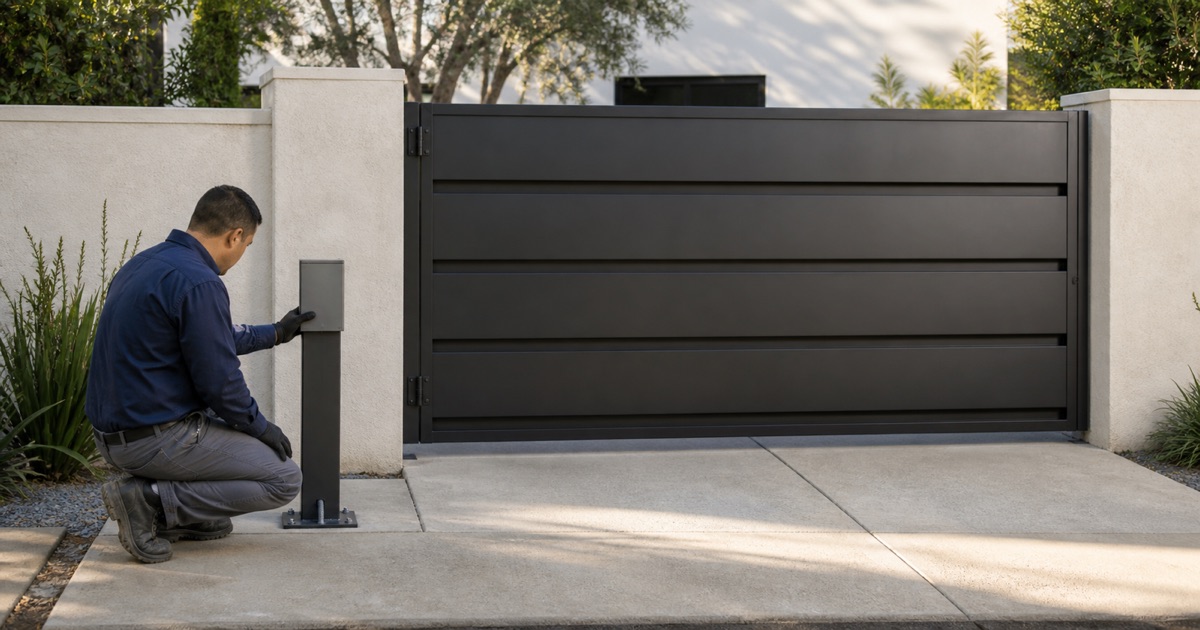
A keypad is the simplest thing that works, needs nobody present, and suits a household or a small site with a handful of codes. Its weakness is code hygiene: a shared code that never changes is no longer access control. Weather is the other consideration, since a keypad mounted where sprinklers reach it will fail at the terminals long before the keys wear out. We mount them clear of irrigation throw and seal the conduit entry from below, because water tracking down inside the conduit is what actually kills most keypads.
Intercoms and Telephone Entry
An intercom puts a person in the decision, which is right where somebody is reliably there to answer and useless where they are not. Telephone entry moves that decision onto a phone, so a visitor at the gate rings a number rather than a panel nobody is standing at. For a building with staff hours but round-the-clock deliveries, the two are often combined. The practical difference is who is inconvenienced when nobody answers: an intercom leaves a visitor standing at the gate, while telephone entry at least rings somebody who can call back.
Cellular and App Control
A cellular controller adds remote opening, a record of who came and went, and the ability to let someone in from anywhere. It depends on signal at the gate and on a live subscription, so we measure coverage at the post before specifying rather than after installing. Where signal is marginal, an external antenna is a cheaper fix than a system nobody trusts.
Readers, Fobs and Cards
Credential-based entry suits any site where individual access has to be granted and withdrawn, which in practice means anywhere with tenants, staff turnover or contractors. The advantage over a code is that revoking one credential does not inconvenience everybody else. The cost is administration, so the handover has to leave someone able to manage it. On a site with real turnover this pays for itself the first time a set of keys is not returned, because nothing has to be rekeyed and nobody else’s access changes.
Detection, Safety and the Standard Behind Them
Exit, Safety and Shadow Loops
Inductive loop detectors cut into the drive do three distinct jobs. The exit loop opens the gate for a departing vehicle so nobody needs a device to leave, the safety loop holds the gate open while a vehicle is over it, and the shadow loop stops a gate closing onto a car waiting in the opening.
Which loops a site needs comes from how vehicles actually queue at that entrance. A driveway where cars wait in the road needs different treatment from a yard where they stack inside the gate, and getting that wrong produces a gate that closes on the third vehicle in a convoy.
Photo Eyes and Safety Edges
A loop cannot see a person, which is the whole reason photo eyes and safety edges exist. A photo eye breaks a beam across the opening; a safety edge reacts to contact with the leaf itself. UL 325 requires monitored external entrapment protection, meaning the operator continuously supervises these devices and refuses to run when one is missing or faulty. That is also why a dirty lens presents as a completely dead gate.
What the Standard Requires of the Gate Itself
ASTM F2200 governs how an automated vehicular gate is constructed so that it cannot trap or shear: mesh and infill dimensions, guarding of the roller path, the gap at the closing edge. Access control installed on a gate that does not meet it is protection layered onto a hazard. We check the gate against the standard before adding controls to it.
Multi-Tenant and Commercial Entrances
Apartment and HOA Communities
A community entrance has to admit residents fast, admit visitors under control, and let a departing car out without a device. It also has to survive a cycle count that would consume a domestic operator in a season. We specify a directory or telephone entry sized to the unit count, per-resident credentials rather than one shared code, and an exit loop so the gate is not being forced by drivers who cannot get out.
Yards, Warehouses and Contractor Traffic
On a commercial yard the traffic is mixed: staff who come daily, deliveries that come once, and contractors who come for a week. That argues for credentials with expiry rather than a single code, and for an intercom to the office covering everyone else. Where trucks queue off a public road, the shadow loop stops being optional. A tractor unit stopped half in the gateway while the driver takes a call is exactly the situation that loop exists for, and it is a routine occurrence rather than an edge case.
Handover That Leaves You in Control
Every system we install is handed over with written instructions for adding and removing users, the manual release explained and demonstrated, and the settings recorded. A manager who cannot revoke a departed tenant’s code without calling us does not really have access control, and the first thing that happens is a shared code that never changes again.
Emergency Access and Failure Behaviour
Getting Fire Crews Through
A Knox box or a fire department key switch lets crews in without cutting the gate, and the California Fire Code’s fire apparatus access requirements govern the widths and clearances behind it. On any gated route an engine would use, this is settled at design stage rather than discovered at plan check.
Power Loss and the Manual Release
Every powered gate needs a defined behaviour when the power goes, and every operator has a manual release that disengages the drive. Battery backup carries a gate through a short outage, and a solar operator with battery backup is designed around that from the start. What matters is that the behaviour is deliberate, tested at handover, and written down where the next person will find it.
- 20+ Years in the Trade
- Free On-Site Measure
- Permit Work Handled