
Lynwood Metal Gates carries out automatic gate installation across Lynwood, CA and the surrounding cities including Huntington Park, Maywood, Montebello, Hawthorne and Lawndale. Because we fabricate gates as well as automate them, the operator is matched to a leaf whose weight we have calculated rather than to an opening we have measured, and that single difference accounts for most of the automation failures we get called to correct.
An operator does not make a gate better. It applies concentrated, repeated force to a structure that was often designed for an occasional push, at a rate no person would manage, several hundred times a month. Every weakness in the gate, the hinges, the post and the footing gets found by the motor, usually within the first year.
So an installation starts with an assessment of whether the gate should be automated at all, and what has to change first if it should. That conversation is cheaper than the alternative, which is a motor slowly destroying a gate somebody paid for twice.
Sizing the Operator
Leaf Weight From the Material List
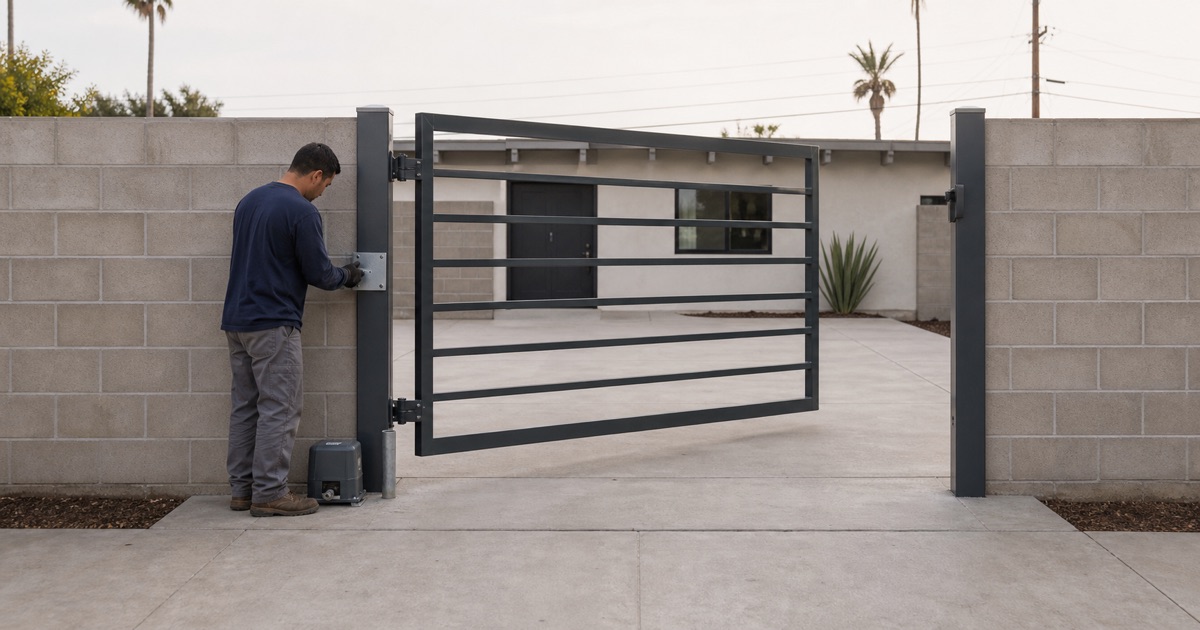
Weight is calculated from the finished material list: sections, infill, hardware and coating. Two gates of identical size can differ by several hundred pounds depending on whether the infill is open picket or solid sheet, and estimating from width is how an operator ends up running permanently at the top of its rating. The calculated figure goes in the job file so a future repair starts from it. Coating adds less than people expect and hardware adds more, which is why the figure is built from the list rather than adjusted by eye at the end.
The Class the Site Falls Into
UL 325 classifies gates from Class I for a single-family residence through Class II for multi-family and commercial sites with public access, Class III for commercial and industrial with limited access, and Class IV for restricted industrial sites. The class carries duty and safety expectations, so it is established at survey rather than assigned afterwards to match equipment already chosen.
Cycles Per Day, Not Gate Size
Duty is about frequency. A community entrance cycling two hundred times a day and a driveway cycling six may need identical force and completely different machines, so we count the real traffic, including the delivery and contractor movements people forget.
An operator failing repeatedly is usually a duty mismatch rather than a bad unit. The pattern is recognisable: the same component fails at roughly the same interval, and each replacement lasts about as long as the last one did.
Operator Types and Where They Suit
Swing Gate Operators
Arm operators push the leaf from a post beside the hinge and suit most residential swing gates, while underground and hydraulic units hide the mechanism and handle heavier leaves and longer duty. The choice comes down to leaf weight, the room beside the hinge post, and how visible the customer will accept the hardware being. Arm operators are far easier to service because everything is reachable, which is worth weighing against the cleaner look of an underground unit on a gate that will be running for twenty years.
Slide and Cantilever Operators
Slide operators drive the leaf through a gear rack or a chain, with the rack mounted to the gate frame and the pinion on the operator. Alignment is everything here: a rack fitted to a leaf that is not running true wears through its teeth quickly and takes the pinion with it. On cantilever gates the operator also has to cope with the leaf being unsupported at the free end for part of its travel.
Solar Operators With Battery Backup
Where no power run exists, a solar operator removes the trench and the electrician entirely. Sizing is an energy calculation rather than a force one, covering daily cycle count and enough reserve for consecutive overcast days. Undersized arrays are the common failure, and they present as a gate that works all summer and stops in December. Sizing to the winter case rather than the average is the whole discipline, and the extra panel costs far less than a second visit and a replacement battery.
Named Operator Brands
We install and service LiftMaster, DoorKing, HySecurity and FAAC operators. Part of that choice is performance and part of it is that parts can be obtained quickly, which on a commercial entrance matters more than a marginal specification advantage.
Building the Gate to Carry It
Posts and Footings for Operator Loads
A gate post carries the leaf as a cantilevered rotating load, and an operator increases both the magnitude and the frequency of it. The municipal code sets posts 24 inches into base soil with a concrete base four inches larger than the post in every dimension, and on heavier powered leaves we exceed that. Footings are left open for inspection before the pour rather than backfilled unverified.
Hinges and Hardware Sized to the Load
Hinges get chosen from the calculated leaf weight, not from the gate’s appearance. Ball-bearing hinges with grease fittings handle a moving load that would flog out a plain barrel, and the latch and drop rod are sized to the same figure. The sizing is recorded, so a later repair does not restart the guesswork.
Meeting ASTM F2200
The standard governs the gate’s own construction so that it cannot trap or shear: infill and mesh dimensions, guarding along the roller path, and the gap at the closing edge. Where an existing gate fails it, that gets corrected before an operator goes on rather than being covered by adding sensors to a hazard.
Power, Commissioning and Handover
Getting Power to the Gate
Mains work means conduit run at the right depth, ideally before a driveway surface is made good rather than after. We plan the route with the groundwork so a drive is not opened twice, and where a gate may be automated later we leave a conduit in place during the original installation because doing so costs very little then and a great deal afterwards.
Safety Devices Installed and Monitored
Photo eyes, safety edges and loops are installed as the operator’s monitored inputs rather than as accessories. The point of monitored external entrapment protection is that the operator refuses to run without them, so they are commissioned as part of the drive rather than added at the end and adjusted until the gate stops complaining.
Force, Limits and Reversing, Set and Recorded
Commissioning sets travel limits, closing force and reversing behaviour, then tests them against an obstruction rather than assuming the factory defaults are appropriate for this gate. Those settings are written down at handover. A record of what the numbers were when the gate was working correctly is the fastest diagnostic anyone will have later.
What You Are Left Holding
Handover covers the manual release demonstrated in person, remote and keypad programming, how to add and remove users, and the written settings record. The aim is that a power cut or a new tenant is something you can deal with yourself rather than a call-out.
- 20+ Years in the Trade
- Free On-Site Measure
- Permit Work Handled