Lynwood Metal Gates designs, builds and installs metal gates in San Gabriel, CA, covering driveway and entry gates, ornamental ironwork, commercial frontages and repairs. Twenty years of setting posts across this county has taught us that the part of a gate job with the most capacity to go wrong is rarely the steel. It is the hole.
That is more true here than almost anywhere else we work. San Gabriel grew around Mission San Gabriel Arcángel, founded in 1771 as the fourth of the twenty-one California missions and moved to its present site in 1776, and the city is reasonably described as the birthplace of the Los Angeles region. Ground with that much history in it is ground where an excavation is not automatically a routine operation.
We are gate builders rather than archaeologists, and the point is not that every post hole is a discovery. It is that on this kind of ground the responsible approach is to dig deliberately, know what to do if something appears, and not treat a footing as a hole to be punched through as fast as possible.
Excavating Carefully
Knowing What Is Under a Property First
Before anything is dug we establish what we can about the site: where services run, what has previously been built there, and whether the property carries any designation or condition that affects ground disturbance. Utility locating is routine everywhere and genuinely necessary on older parcels, where runs are frequently not where any drawing says. On a property with any historic status the permitted extent of excavation is a question to settle before quoting rather than after starting.
Digging Deliberately Rather Than Quickly
A post hole dug with a machine in two minutes and one dug carefully in fifteen produce the same footing, and only one of them gives anybody a chance to notice something. On ground of this kind we dig at a pace that allows the spoil to be seen, particularly on the older parcels near the mission where the historical layers are shallower than people assume.
If Something Does Appear
If material of apparent age or interest comes out of an excavation, work in that hole stops and the property owner is told before anything else happens. That is not a complicated position and it costs a delay rather than a job. Continuing and saying nothing is the alternative, and it is the wrong one for reasons that have nothing to do with what it might cost later.
Working Near Old Structures
Where a gate is going in close to old masonry, the vibration from mechanical excavation is a genuine consideration rather than a theoretical one. Hand digging the last part of a hole near a wall or footing of real age is slower and avoids the risk entirely. We would rather quote that time honestly than discover a problem after the fact.
Looking for metal gates closer to Huntington Park? See Metal Gates in Huntington Park.
Footings That Hold
What a Gate Post Actually Resists
A gate post is resisting rotation rather than weight. The leaf hangs off one side and tries to turn the post over, every time the gate swings and continuously whenever wind loads the panel. That means the footing is working laterally, against the ground around it, and its width and shape matter as much as its depth. We size it against the calculated leaf weight and the exposed area rather than reaching for a standard detail.
Made Ground and Mixed Fill
On parcels that have been built on, cleared and rebuilt across a long period, what is under a driveway is frequently not natural ground at all but fill of unknown composition and compaction. That is the situation where a footing dug to a nominal depth can be sitting in material that will not resist anything. We check what the spoil actually is, and where it is poor we go deeper or wider rather than pouring into it and hoping.
Inspection Before the Pour
We leave excavations open for inspection before any concrete goes in. Once a footing is poured and backfilled, nobody can tell what shape it is, what it is bearing against or how deep it truly went, and it is the single element of a gate installation that cannot be corrected afterwards without taking the gate down. On ground like this it is also the element most worth a second pair of eyes.
Ironwork That Suits the Setting
Reading the Street
San Gabriel holds buildings of very different ages within short distances, and a gate that suits one frontage can look imported on the next. We draw against an elevation of the actual property, setting gate height, top rail depth and picket rhythm relative to the building’s own divisions, because proportion rather than style is usually what makes ironwork look as though it belongs.
Detailing Near Historic Fabric
Where a gate sits close to genuinely old work, the honest approaches are either a quiet, well-proportioned design that does not compete, or a considered reproduction of a period detail. What does not work is a catalogue pattern chosen because it is broadly Spanish. Where a property already carries ironwork we take the picket dimensions, spacing, rail depths and any scroll detail off the existing work and reproduce them.
Finish and Long Life
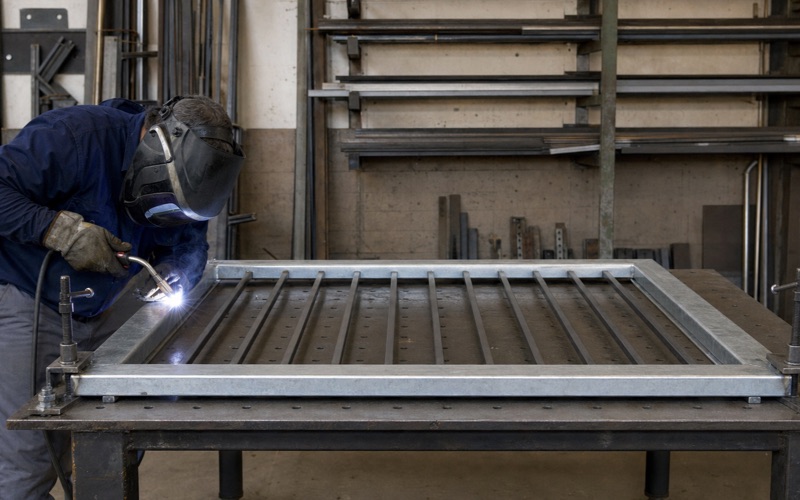
A gate that is meant to be looked at needs the finish done as a sequence rather than a single operation: welds dressed back and inspected, zinc-rich primer onto the joints, then a TGIC polyester powder coat over the whole leaf. A coating applied over an undressed weld looks identical on the day of handover and lifts from underneath within a couple of years, starting at the hinge lugs where nobody looks.
Commercial Work, Automation and Handover
Frontages and Enclosures
The commercial work here is the usual range: security gates on retail and restaurant frontages, service yard entrances, and screened enclosures required by the local zoning provisions. Enclosure gates take daily impact from bins and equipment, so the frame is built heavier than the span alone would suggest and the hinges are sized well above the leaf weight. The applicable requirement is the local one, which we check for the city the site is in.
Automation Without Overloading the Post
An operator applies concentrated repeated force to the leaf, the hinges and ultimately the post and its footing. Where a gate is to be powered we increase the footing rather than only the hardware, size the operator from the calculated leaf weight and the real cycle count, and fit monitored entrapment protection because UL 325 requires the operator to supervise its own safety devices. Loops see vehicles and photo eyes see people; one does not replace the other.
Local Rules and What We Leave You
San Gabriel writes its own fence and gate provisions, and they are not Lynwood’s. Height limits, permitted materials and setback rules differ genuinely across a city line here, and a property with historic status may carry conditions beyond the general provisions. We confirm what applies to the specific address. Every job is handed over with the measured opening, the leaf weight calculation, the hardware sizing and the footing as actually built, which on this ground is the record most worth having.
Repairs and Older Ironwork
Assessing What Is Worth Keeping
A good deal of the ironwork on the older streets here is decades old, structurally sound under a poor coating, and detailed in ways that would be expensive to reproduce. Stripping and recoating costs a fraction of replacement, so the decision turns on the frame rather than the finish: square corners and sections with their wall thickness intact mean the piece is worth saving. We assess that before quoting anything, because the default advice to replace is very often wrong on gates of this age.
Repairing Rather Than Replacing a Section
Where corrosion has taken a bottom rail or the foot of a picket, that part is cut out and new material let in, then primed and recoated with the rest of the leaf. That keeps the original detailing and the original proportions, which on a street with genuine architectural character is usually the whole point. A modern reproduction of an older pattern rarely matches convincingly, and the mismatch shows most at exactly the details that made the original worth keeping.
Hardware and the Post Underneath
A restored gate often goes back on its original hinges, which is a mistake if those hinges are why it failed. We size ball-bearing hinges with grease fittings against the calculated leaf weight and replace the latch and drop rod where they were undersized. We also check the post, because on ground that may be fill of unknown compaction, a gate that has dropped has frequently been let down by its footing rather than by its ironwork.
What Regular Attention Prevents
Hinges that have begun to bind, a latch that needs lifting to engage, coating lifting at a weld — all of these announce themselves well before anything fails. A periodic service that greases the hinges, checks the fixings, touches in the finish and tests the closure costs very little against a call-out, and on ironwork worth preserving it is what keeps a repair a repair rather than a rebuild.
- 20+ Years in the Trade
- Free On-Site Measure
- Permit Work Handled