Lynwood Metal Gates supplies, installs and maintains metal gates in Rosemead, CA, across utility and industrial premises, commercial frontages and residential streets. Twenty years of building vehicle gates in this county means we are used to the requirement this city produces more than most: an entrance that has to keep almost everybody out while never delaying the people who are entitled to come through it at three in the morning.
Those two demands pull in opposite directions, and most gates resolve the tension badly. A perimeter tightened until it is genuinely secure is usually a perimeter that a crew responding to a fault has to fight, and the predictable consequence is that somebody arranges for it to be easier — a code shared, a padlock swapped, a leaf left unlatched.
So on this kind of site we treat crew access as a design requirement of equal weight to the security itself, rather than as something to be bolted on once the perimeter is decided.
Restricted Perimeters and Round-the-Clock Access
Designing for the Three in the Morning Case
The test of a restricted-access gate is not the daytime visit but the emergency one, in the dark and the rain, by somebody who may never have been to that site before. That argues for entry that works without a phone call, without a specific individual being reachable, and without a key that lives in one person’s pocket. Where the route through is harder than that at the worst moment, the workaround appears within weeks and the perimeter is finished.
Credentials That Can Be Withdrawn
A single shared code is not access control on a site with contractors and shift crews, because it never gets changed after somebody leaves. Individual credentials can be issued and revoked without inconveniencing anyone else, which matters most on exactly the sites that have real turnover. The cost is administration, so the handover has to leave a named person able to add and remove users without calling us for a routine change.
Manual Override That Is Not a Weak Point
Every powered gate needs a defined behaviour when power fails, and every operator has a manual release. On a restricted perimeter that release is also a potential vulnerability, so where it can be reached from outside the boundary it has to be secured in a way that a crew can still operate but a passer-by cannot. We settle that deliberately at design stage rather than discovering it during the first outage.
Looking for metal gates closer to Redondo Beach? See Redondo Beach Metal Gates.
Industrial and Utility Sites
A City With Real Infrastructure
Rosemead is the headquarters of Southern California Edison, part of Edison International, and it carries manufacturing including Huy Fong Foods. Sites of that kind bring boundary requirements that an office park does not: equipment that is genuinely hazardous to approach, clearances that have to be maintained, and access that is restricted for safety reasons as much as for security ones. A gate on that sort of boundary is doing a different job from one protecting stock.
Gates on Working Yards
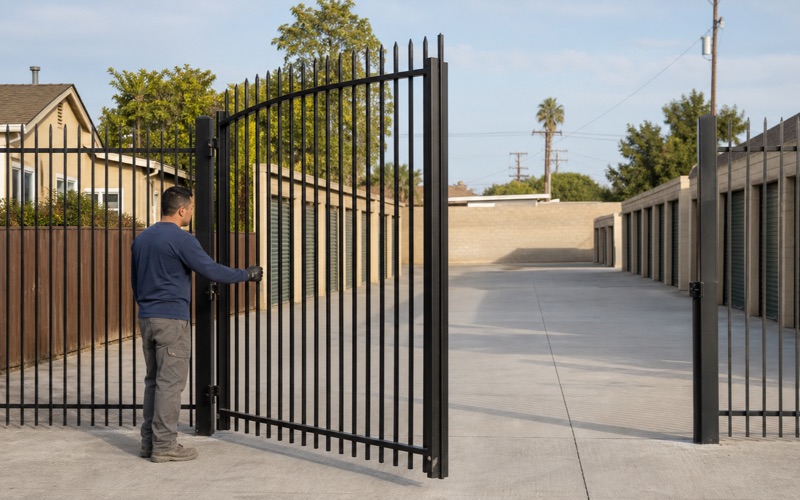
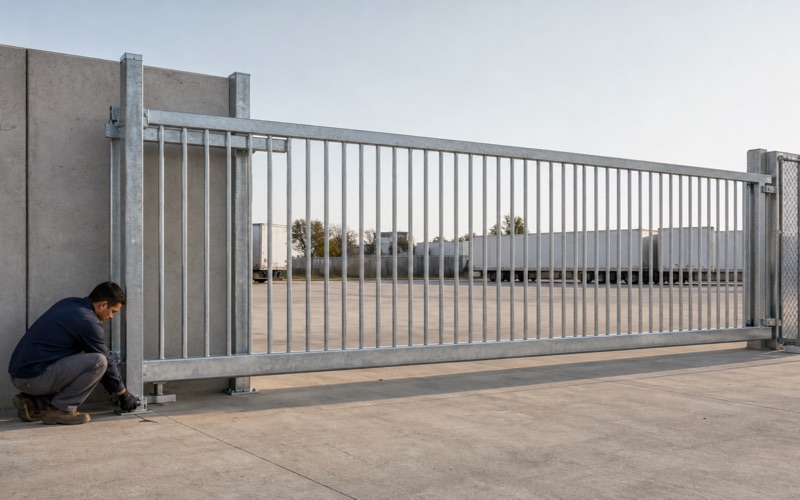
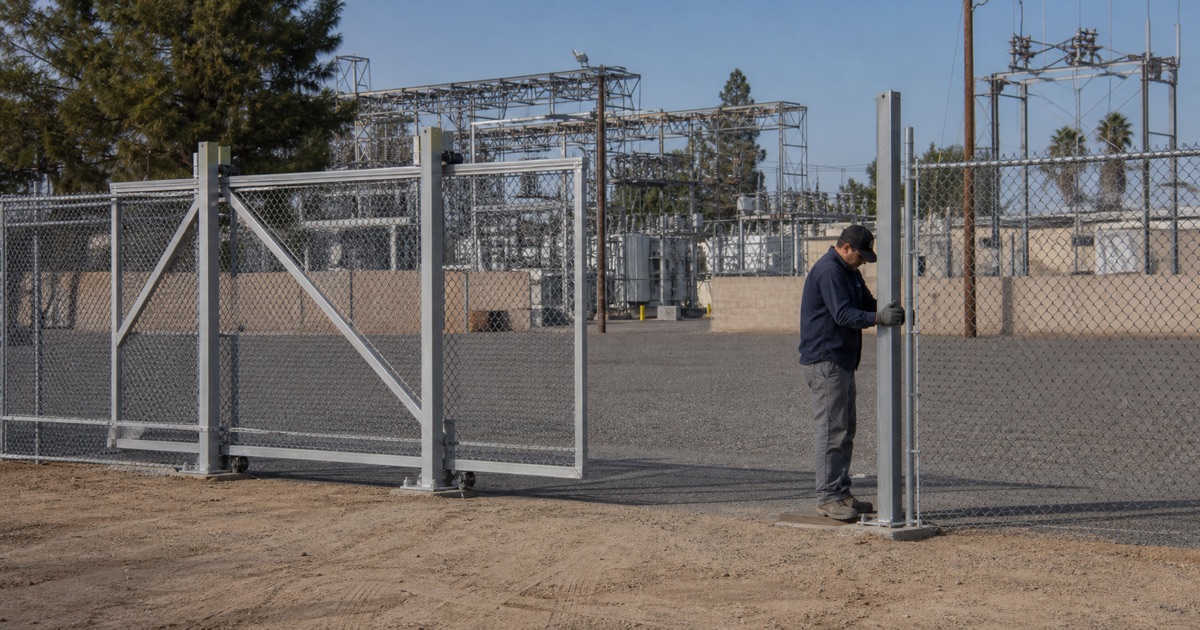
A yard entrance passing heavy vehicles all day suits a cantilever slide gate, because the leaf runs on truck assemblies behind the opening and never touches a surface that has been churned up. We size the counterbalance against the span and check the available backrun before proposing one, and we size the trucks, posts and footings to the actual leaf rather than scaling a smaller design upward and hoping it stays straight.
Duty Rating and Serviceability
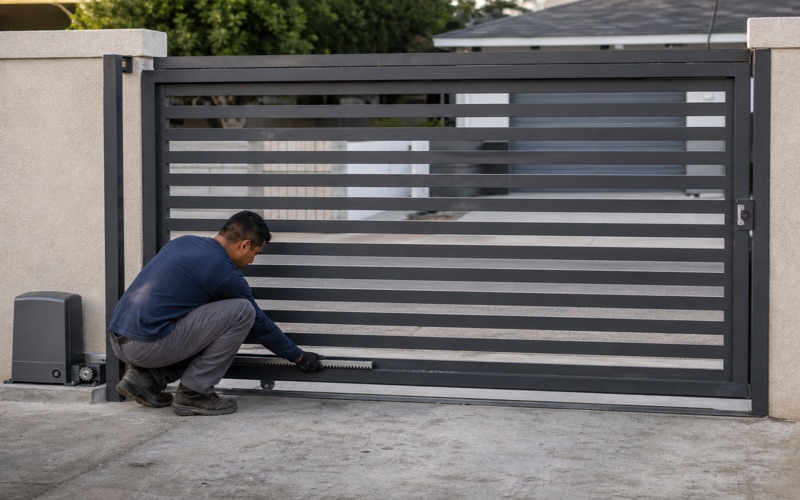
On a site where the gate is effectively production equipment, availability of parts outranks marginal performance. UL 325 classifies operators up to Class IV for restricted-access industrial use, and we specify from the real cycle count including shift changes and deliveries. Operators from LiftMaster, DoorKing, HySecurity and FAAC are favoured partly because a failed component can be replaced quickly, and the commissioned settings are written down so a call-out does not begin from nothing.
Emergency Access Designed In
A Knox box or fire department key switch lets crews in without cutting the gate, and fire apparatus access requirements govern the widths and clearances behind it. On an industrial or utility site this is settled during design, because retrofitting emergency access to a commissioned controlled-access gate means reworking controls as well as ironwork, and a plan check that comes back against you is far more expensive than the provision would have been.
Commercial and Institutional Frontages
Screening, Enclosures and What the Zone Requires
A good deal of commercial gate work is not about intrusion at all but about screening: trash and storage enclosures, plant compounds and service yards that have to be closed off from view. Those requirements come from the local zoning provisions and vary by city and by zone, so we establish what actually applies rather than assuming. Enclosure gates take daily impact from bins and equipment, so the frame gets built heavier than the span alone would require.
Perimeters That Have to Be Maintained
A perimeter is only as good as its weakest opening, and on a long commercial boundary that is usually a gate somebody stopped looking at years ago. A worn latch, a hinge that has dropped, a drop rod that no longer reaches its sleeve — each is small and each defeats the whole run. We would rather service a commercial perimeter periodically than replace sections of it, and the components that matter give warning long before they fail.
Detailing the Closure
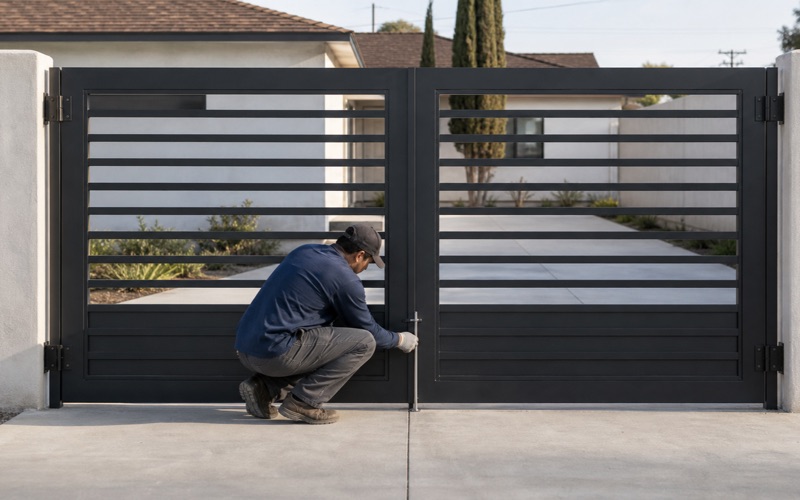
On a double-leaf gate the closure is where a perimeter is actually defeated, so it gets detailed as carefully as the leaf. That means a drop rod into a sleeve set in concrete rather than a surface plate, meeting stiles that overlap instead of butting, and locks and keeps taken into masonry or steel rather than fixed to a surface. The strongest gate on a weak fixing is a weak gate.
Residential Streets
Driveway and Entry Gates
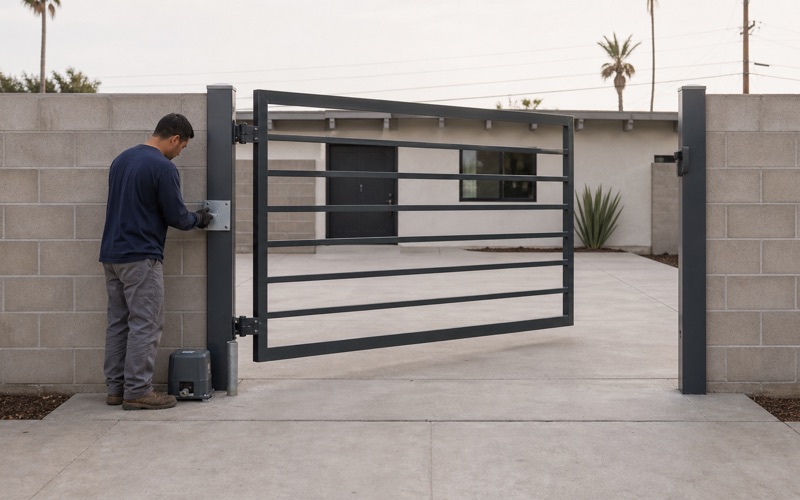
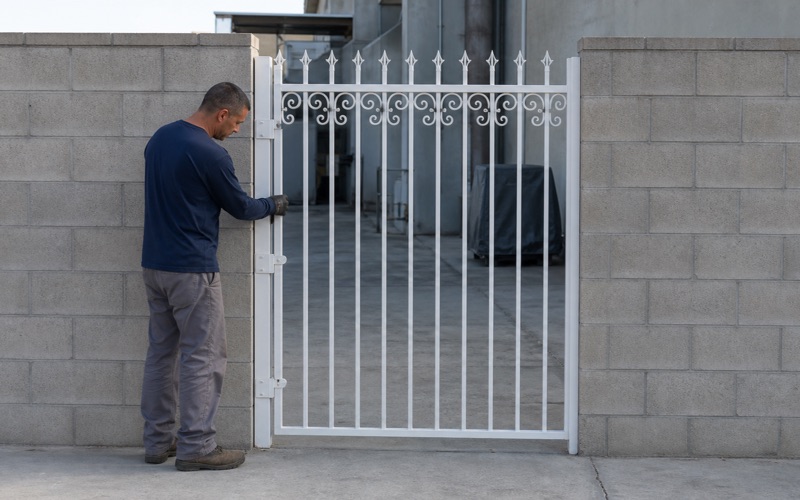
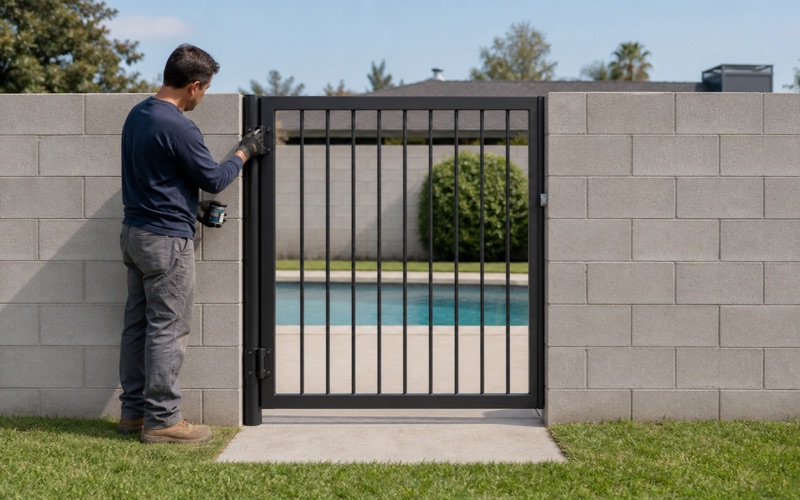
Away from the industrial parcels Rosemead is largely suburban, developed through the middle of the last century on what had been ranch and agricultural land named for Leonard Rose’s Rose’s Meadow. The gates here are the ordinary ones: driveway leaves, pedestrian and side gates, and ornamental ironwork. The questions are whether there is arc for a swing gate, whether a pair beats a single, and whether the drive has been resurfaced since anything was last hung.
Automation on a Domestic Driveway
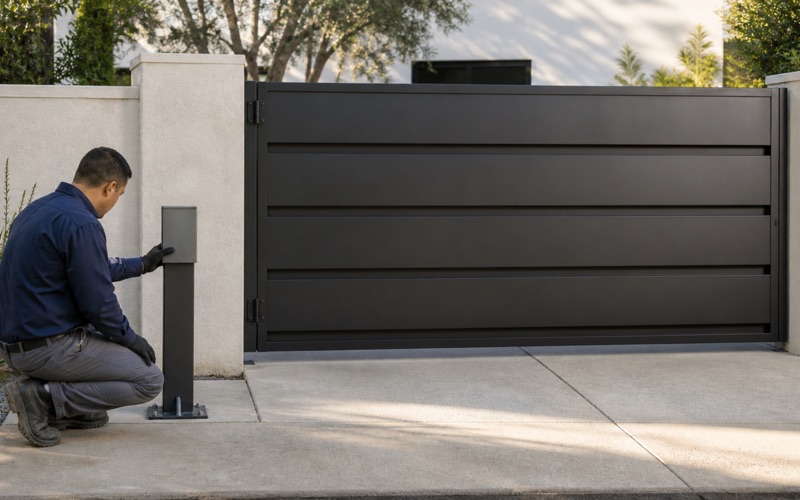
Where a household gate is to be powered, the operator gets sized from the calculated leaf weight and the real cycle count rather than from the opening width, and monitored external entrapment protection is fitted because UL 325 requires the operator to supervise its own safety devices. Loops see vehicles and photo eyes see people, and one does not substitute for the other regardless of how quiet the driveway is.
Local Rules and What We Hand Over
Rosemead writes its own fence and gate provisions and they are not Lynwood’s; height limits, permitted materials and setback rules differ genuinely across a city line here. We confirm the rules of the city the gate is going in. Every job is handed over with the measured opening, the leaf weight calculation, the hardware sizing and any commissioned operator settings in writing, so the gate remains maintainable by whoever comes next.
Material, Finish and Long-Term Maintenance
Building for a Twenty-Year Boundary
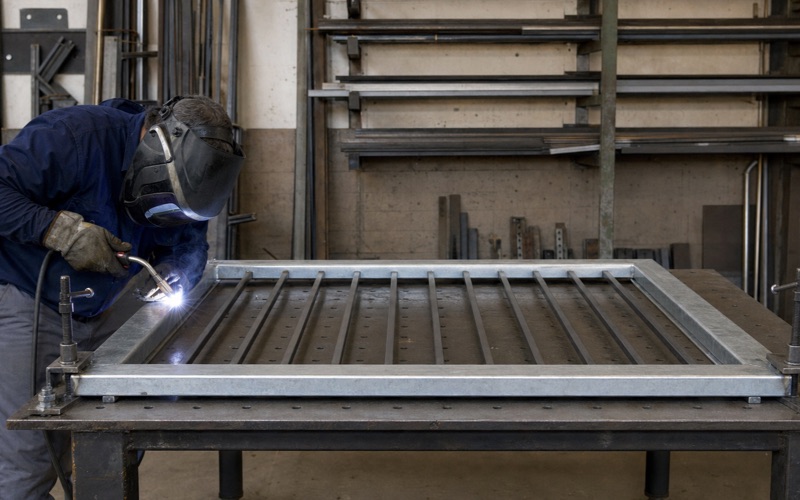
An industrial perimeter gate is a steel job: tube to ASTM A787, welded and braced, sized against the span rather than scaled from a smaller design. Every load-bearing weld is dressed back and inspected before coating, because a finished powder coat conceals the joint it is meant to protect and there is no way to assess it afterwards. Zinc-rich primer goes onto the joints and a TGIC polyester powder coat over the whole leaf, with hot-dip galvanizing to ASTM A123 underneath where the exposure justifies it.
Fixings and Cable Runs
On a gate that is otherwise well built, the first thing to fail is almost always a fixing rather than a member. Properly protected fasteners cost very little more than plated ones and last several times as long. On a powered or controlled gate the same thinking extends to the cable runs and enclosure glands, because water tracking down inside a conduit into a control board is among the most common faults we attend and it is entirely preventable at installation.
A Record That Survives Staff Turnover
On a site with shift managers and contractors, the most useful thing we leave behind is often the paperwork rather than the ironwork. The measured opening, the calculated leaf weight, the hardware sizing and the operator’s commissioned force, travel and reversing settings all go into a written record handed over with the gate. When a fault appears years later and nobody remembers who installed what, that document turns a diagnostic exercise into a straightforward comparison.
Knowing Which Rule Actually Applies
On an industrial or utility site the requirement for a gate rarely comes from one place. Zoning sets what may be built and how high, a lease or a landlord may impose more, an insurer often has its own view, and on a hazardous boundary there are safety clearances that outrank all of them. We establish which of those is driving the specification before drawing anything, because designing to the wrong one produces a gate that satisfies somebody and fails an inspection by somebody else.
- 20+ Years in the Trade
- Free On-Site Measure
- Permit Work Handled