Lynwood Metal Gates builds, installs and services metal gates in Redondo Beach, CA, across harbour and boatyard property, commercial frontages and residential streets. Twenty years of specifying gates around this county means we know which jobs need a different material conversation before anything else is discussed, and work near a working harbour is firmly one of them.
A gate on the water is not simply a gate in a damper place. Salt in the air is continuously depositing on every surface, working into every joint and behind every fixing, and it does not stop when the weather is good. Ordinary specifications that last decades a few miles inland have a very different life here, and the failures start at the places nobody inspects.
The second thing that changes is what the gate is for. Around a harbour, access control is about controlling a boundary between a public promenade and a private berthing area, with pedestrians rather than vehicles as the main traffic, and that is a different design problem from a driveway.
Gates in a Marine Environment
Where Salt Actually Attacks
Corrosion near the water does not start on the flat faces anybody can see. It starts in the crevices: inside a hollow section that was never sealed, behind a hinge leaf, under a washer, inside a lock housing and in the gap between two members that were welded on three sides. Those are the places salt collects and stays wet longest, and they are all invisible until the component fails. We detail to eliminate the traps rather than relying on a coating to survive them.
The Coating System That Justifies Itself Here
Inland, the difference between a good and an adequate protection system shows up in twenty years. Here it shows up in three. Welds are dressed back and inspected, hollow sections are sealed, zinc-rich primer goes onto every joint, and hot-dip galvanizing to ASTM A123 goes underneath the TGIC polyester powder coat rather than being treated as an optional upgrade. That is the specification we would recommend for anything within reach of the spray.
Aluminium and Where It Wins
Aluminium extrusion in 6005-T5 or 6061-T6 does not rust at all, which on the waterfront is a strong argument regardless of its other properties. It is lighter for the same span, so hinges and operators work less, and it needs no maintenance to keep its integrity. The trade is that it dents where steel would resist, so on a gate that takes trolley and equipment contact we will often still specify steel and protect it properly instead.
Fixings Are the Weak Link
On a well-built gate near the sea, the first failure is almost always a fastener rather than a member. Stainless fixings of an appropriate grade cost very little more than plated ones and last several times as long, and mixing metals carelessly at a fixing creates a galvanic problem that will outrun the coating entirely. We specify the fixings deliberately, because a sound gate hanging on corroded bolts is not a sound gate.
Looking for metal gates closer to Culver City? See Metal Gates in Culver City.
Harbour and Boatyard Access
The Boundary at the Water
King Harbor and the Municipal Pier put a great deal of public frontage directly against private and operational areas, and gates on that line are doing something specific: separating a promenade anybody can walk along from berths, yards and service areas that not everybody should reach. That boundary carries constant foot traffic on one side, which makes reliability and ease of legitimate use far more important than it would be on a vehicle gate.
Gangway and Dock Gates
A gate at the head of a gangway or a dock has particular constraints: it may be on a structure that moves, it is walked through with hands full, and it has to close reliably behind somebody who is not thinking about it. Self-closing hardware has to be genuinely reliable from small openings rather than only from wide open, and the latch has to work one-handed. We test closers from several positions rather than releasing them from fully open, where almost anything will swing shut.
Yard and Compound Gates
A boatyard entrance takes trailers, travel lifts, forklifts and vehicles carrying awkward loads, over a surface that gets wet and gritty. A sliding or cantilever arrangement generally suits that better than a swing pair, because there are no leaves projecting into the path of something being manoeuvred. Where a cantilever is used we size the counterbalance and check the backrun, and we expect to talk about impact protection for the posts.
Commercial and Residential Work
Frontages Near the Water
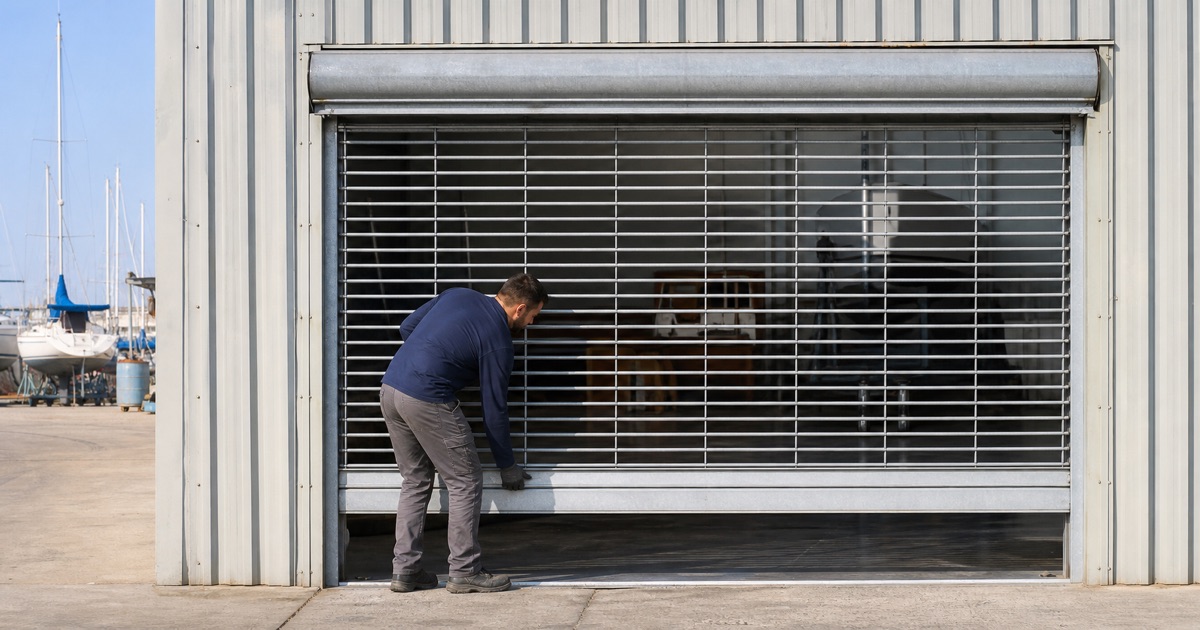
Commercial premises along this stretch face the same corrosion problem as the harbour itself, and it is routinely underestimated because the building is a street back from the water. Security gates, roller shutters and grilles here need the marine specification rather than the inland one, and the components that fail first are the moving parts: guides, bottom bars, pivots and the tracks that scissor gates run in.
Residential Gates and Ironwork
The residential work is the ordinary range of driveway leaves, pedestrian gates and ornamental ironwork, with the same material question running underneath it. Where a homeowner wants steel for the look and the strength, we specify the full protection system and say plainly what maintenance it will want. Where nobody is realistically going to maintain anything, aluminium is the honest recommendation even though it is not what was asked for.
Automation Near Salt Air
Operators, control boards and access devices suffer in this environment more than the ironwork does, because the enclosures are rarely as well sealed as people assume. Water and salt track down inside conduit and sit on terminals, which is among the most common faults we attend anywhere and is considerably more common here. We run cable so it drains away from the enclosure, gland it properly, and specify units appropriate to the exposure rather than the cheapest that fits.
Specification, Rules and Handover
Local Rules, Checked Locally
Redondo Beach sets its own fence and gate requirements, and they are not Lynwood’s. Height limits, permitted materials, what may sit within a front setback and what may project toward a public walkway all vary genuinely across a city line in this county, and coastal frontage frequently brings additional considerations. We confirm the rules of the city the gate is going in rather than carrying an assumption across a boundary.
Maintenance That Is Actually Realistic
A gate here will want attention, and the specification should assume the least attention it is likely to get rather than the most. Hinges with grease fittings can be serviced without dismantling anything, sealed sections have nowhere for water to sit, and a finish that can be made good locally beats one that has to be redone whole. We say at handover what wants doing and how often, in plain terms.
The Written Record
Every job is handed over with the measured opening, the calculated leaf weight, the hardware sizing and any commissioned operator settings written down. On property that changes hands or changes manager, and on a waterfront where a repair years later may be urgent, that record is often the only surviving description of what was actually built and what it was built from.
Repair, Restoration and Knowing Which
What Corrosion Has Actually Done
A gate near the water almost always looks worse than it is, because surface rust on sound steel is a preparation problem rather than a structural one. The decision turns on the frame: square corners and sections that still have their wall thickness mean the leaf is worth restoring, whatever the finish looks like. Once the corners have opened or the sections flex under hand pressure, the geometry has gone and anything done to it is temporary. We assess the frame and the post before recommending either route.
Cutting Out and Letting In
The classic repairable failure here is corrosion concentrated at the bottom rail and the foot of each picket, where salt-laden water sits longest. That section is cut out, new material let in, the joint primed and the whole leaf recoated, which is a fraction of the cost of replacement and keeps detailing that may no longer be obtainable. On a waterfront property that has had the same ironwork for decades, that is usually the outcome the owner actually wants.
Hardware Replaced Rather Than Reused
A restored gate very often gets its original hinges put straight back on, which is a mistake if those hinges were what failed. We size ball-bearing hinges with grease fittings against the calculated leaf weight, replace the latch and drop rod at the same time if they were undersized, and specify fixings appropriate to the exposure. Doing that during a restoration costs very little and removes the next failure before it starts.
Servicing Before Something Fails
On this coast the components that go first give warning: a hinge that has begun to bind, a latch that needs a lift to engage, a lock that is stiff in the morning. A periodic service that greases the hinges, checks the fixings, touches in the coating and tests the closers costs a fraction of a call-out and is the difference between a gate that lasts twenty years and one that lasts eight.
- 20+ Years in the Trade
- Free On-Site Measure
- Permit Work Handled