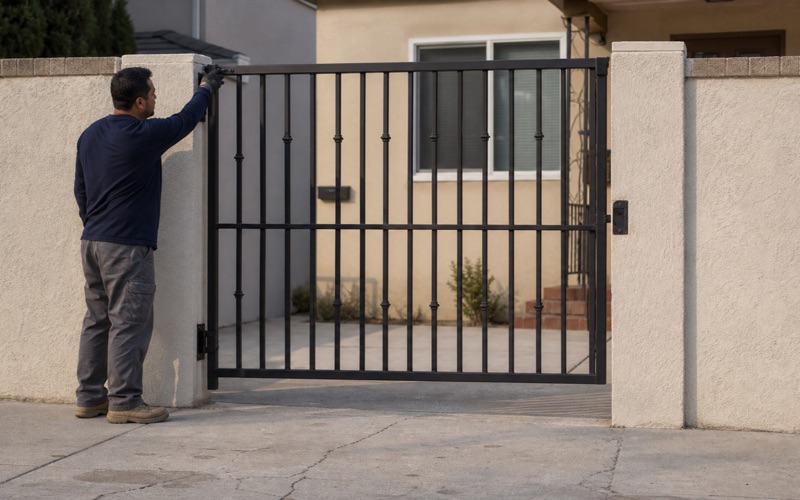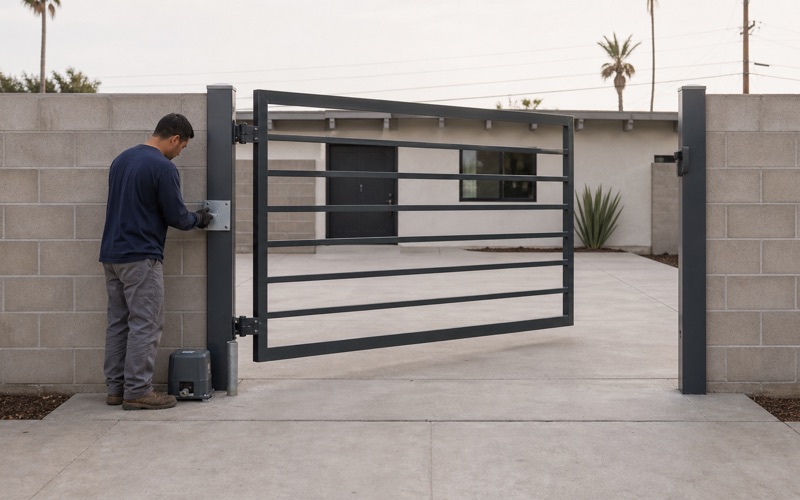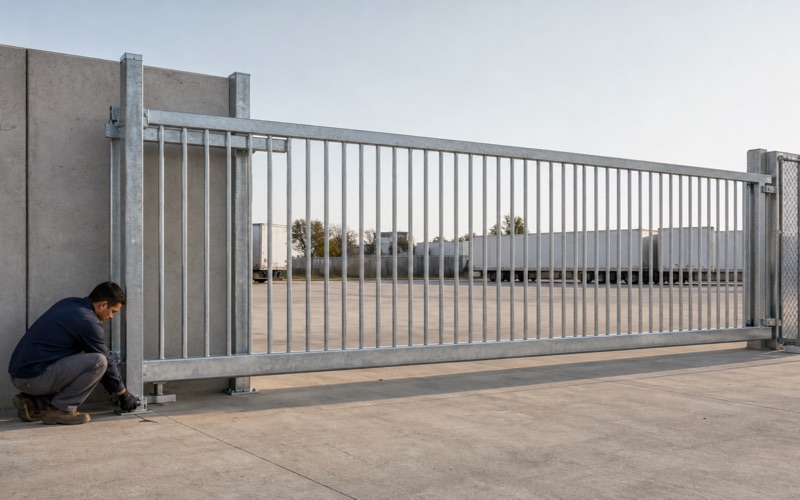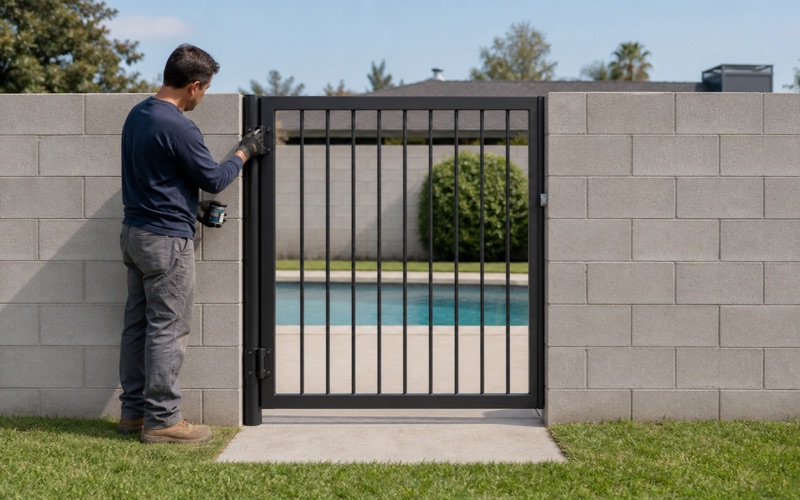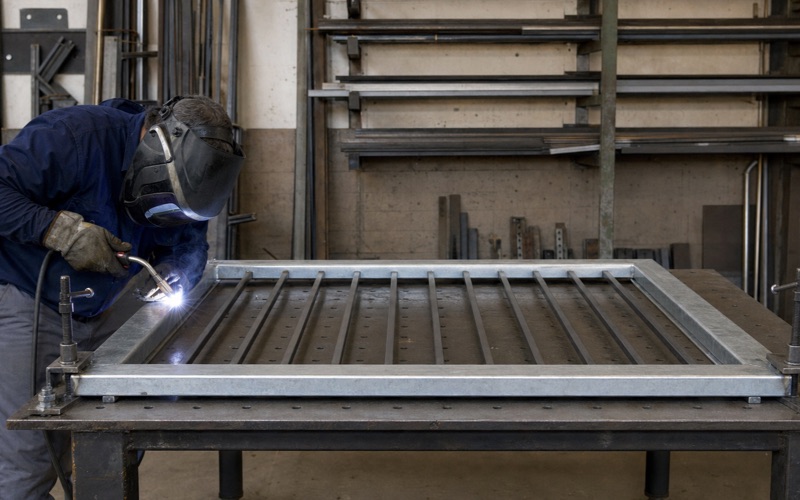
Lynwood Metal Gates designs and installs metal gates in Monterey Park, CA, covering entrance and driveway gates, ornamental ironwork, automation and repairs. Twenty years of drawing gates for openings across this county has taught us that on some streets a gate is a security item and on others it is the front door of the property, and that the second kind is judged far more closely.
Monterey Park is emphatically the second kind. The entrance here is understood as a considered element of a house rather than a fitting bolted across a driveway, and clients arrive with clear views about proportion, orientation and balance. Those are legitimate design requirements, and treating them as decoration is how a gate ends up technically sound and quietly wrong.
So the conversation on a job here starts with the entrance as a whole: which way it faces, what sits behind it, how the two leaves relate to each other and to the pillars, and where the eye is meant to settle. The steel follows from that.
Designing the Entrance, Not Just the Gate
Orientation and Approach
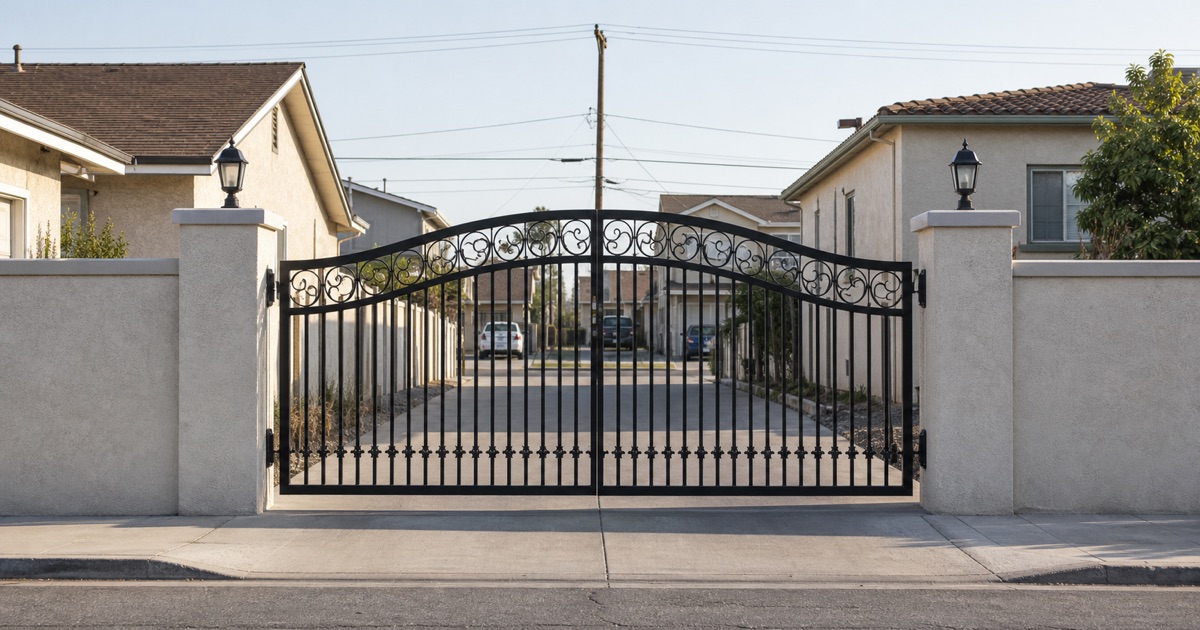
The direction an entrance faces and the way a visitor approaches it change what the gate has to do. A gate seen straight on from the street is read as a single composition and needs to be genuinely symmetrical, while one approached at an angle is read as a sequence and can carry more variation across its width. We look at the actual approach before drawing, because a design that balances on paper can sit visibly off-centre in the only view anybody ever has of it.
Symmetry, and Where It Has to Be Exact
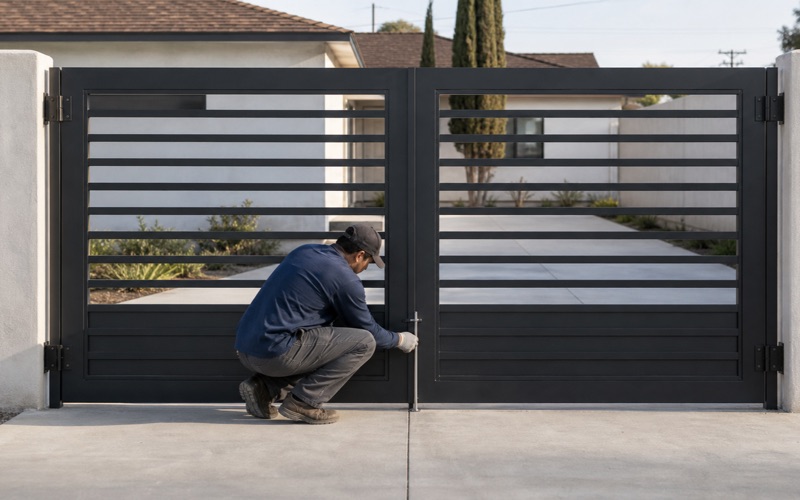
On a pair of leaves the eye finds any discrepancy at the meeting stile immediately, and it is unforgiving about it. That means the two leaves have to be equal, the meeting detail has to sit on the centreline of the opening, and any ornament has to mirror rather than merely balance. Where an opening is not itself symmetrical, which is common once a driveway has been widened at some point, we resolve it in the pillars or the fixed panels rather than by making one leaf wider and hoping.
Proportion Against the House
A gate that is right for one frontage looks imported on the next, and the variable is almost always proportion rather than style. We draw against an elevation of the actual house, setting the gate height, the depth of the top rail and the picket rhythm relative to the building’s own divisions. That is what makes a gate look as though it belongs to the property rather than having been selected for it.
Looking for metal gates closer to Alhambra? See Metal Gates in Alhambra.
A City Where the Entrance Matters
Why Expectations Are Higher Here
Monterey Park became, in 1990, the first city in the continental United States with an Asian-majority population, and it has long been known as Little Taipei, with its business district centred on Garfield and Garvey. Among the things that came with that is a well-established tradition of treating the entrance to a home as a considered and meaningful element rather than an afterthought. Clients here are more likely to have thought about orientation and balance before we arrive, and to notice when a gate has not.
Working With a Client Who Has a View
Where someone arrives with specific requirements about how an entrance should be arranged, our job is to make those work structurally rather than to talk them out of it. Most of what gets asked for is achievable: a specific opening direction, a particular width relationship between leaves, a solid lower panel with an open upper. What we will say is where a requirement conflicts with the mechanics, and then find the version that satisfies both.
The Hillside Question
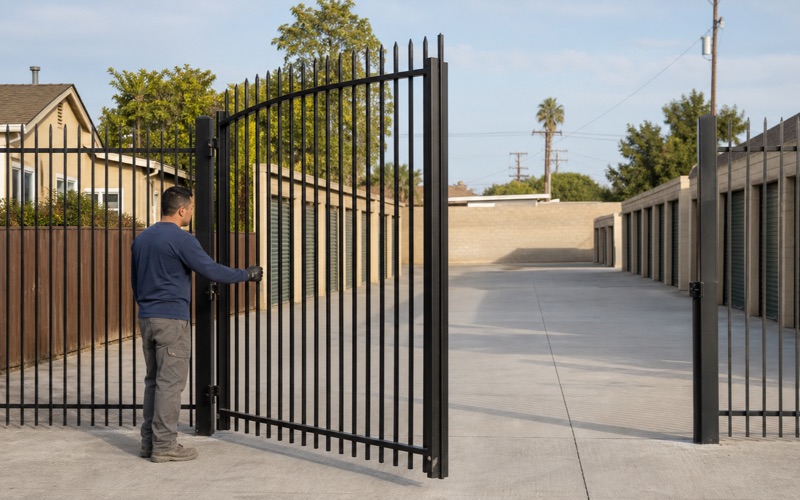
The city sits between the Garvey and Monterey Hills, and a meaningful number of its driveways are on a grade. A slope across the arc of a swing leaf is the single most common reason a gate binds partway through its travel, and it is not something that can be corrected afterwards by adjusting hinges. We measure the fall across the whole arc rather than at the opening alone, and where the grade is real we design around it with a slide gate or with leaves hung to clear.
Detailing and Material
Ornamental Iron and What It Can Carry
Ornamental ironwork gives an entrance presence without giving the wind much to push against, because most of its area is air. Scroll, panelled infill, varied picket rhythm and a worked top rail all add visual weight cheaply in structural terms. Where a solid or partly solid panel is wanted for privacy, that changes the load on the hinges and post substantially, so it becomes a hardware decision as well as a design one.
Finish That Holds Its Appearance
On a gate that is meant to be looked at, the finish matters as much as the form, and it is a sequence rather than a product. Welds are dressed back and inspected, zinc-rich primer goes onto the joints, then a TGIC polyester powder coat over the whole leaf. A coating applied over an undressed weld looks identical on the day of handover and lifts from underneath within a couple of years, which on an entrance gate is exactly the failure nobody will tolerate.
Hardware That Keeps the Geometry
Symmetry that is right on the day of installation is worth nothing if one leaf drops. We calculate leaf weight from the finished material list and size ball-bearing hinges with grease fittings against it, with the latch and drop rod sized to the same figure and the calculation kept in the job file. On a paired gate this matters twice over, because a single dropped leaf destroys the whole composition rather than just its own alignment.
Automation, Permits and Handover
Automating Without Spoiling the Entrance
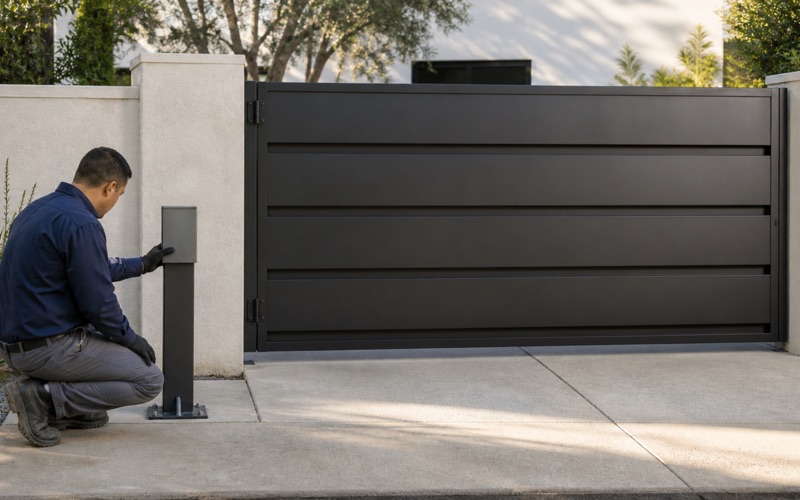
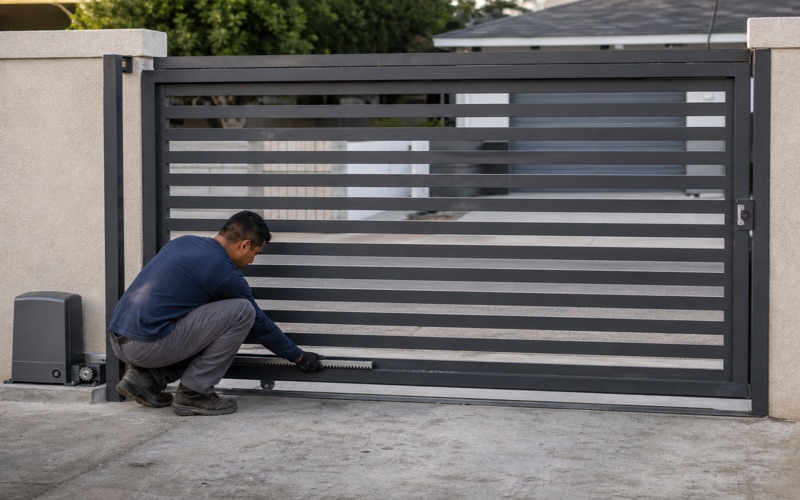
Operators can be hidden. Underground and concealed units keep the hardware out of the composition entirely, at the cost of being harder to service later, while arm operators are easier to maintain and more visible. On an entrance where appearance is a primary requirement we will usually recommend concealing the drive, and we make sure the customer understands the servicing trade before choosing it rather than afterwards.
Sizing the Operator Properly
An operator has to be matched to the calculated leaf weight and the real cycle count, not to the width of the opening. UL 325 sorts operators by the class of site they serve, and monitored external entrapment protection is required regardless of how discreet the installation is. Concealing hardware never means omitting safety devices, and photo eyes and safety edges get positioned to be effective and unobtrusive rather than left off.
Local Rules and What Gets Handed Over
Monterey Park writes its own fence and gate provisions, and they are not Lynwood’s; height limits, permitted materials and setback rules differ genuinely across a city line here. We confirm the rules of the city the gate is going in. At handover you get the measured opening, the leaf weight calculation, the hardware sizing and, on a powered gate, the commissioned force and travel settings in writing, which is what makes the entrance maintainable by whoever looks after it next.
Fences, Railings and the Rest of the Frontage
The Gate Is Rarely on Its Own
An entrance gate almost always sits within a run of fence, railing or wall, and a gate detailed beautifully against pillars that do not relate to it reads worse than a plainer design that belongs. We look at the whole frontage, including where the run stops, how it turns a corner and what happens at the property line, and we design the gate as part of that rather than as an object dropped into it. Where the existing run is staying, the gate is drawn from its dimensions rather than from a standard.
Pedestrian Gates and the Second Opening
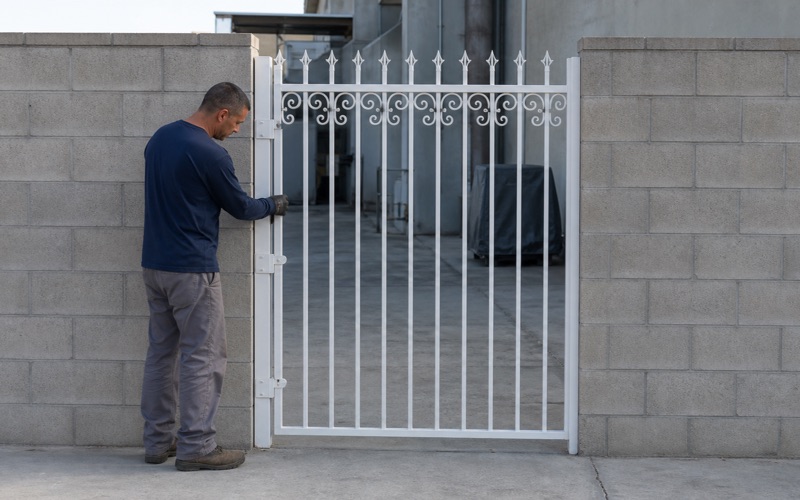
Most entrances here have a second, smaller opening for people, and it is the one used constantly while the vehicle gate opens twice a day. That difference in duty is routinely missed, and the pedestrian gate is built as a scaled-down version of the driveway leaf. We build it heavier at the hinge than its size suggests and fit hardware sized well above the leaf weight, because a small gate opened many times daily wears at a rate a large one never approaches.
Steps, Levels and Handrails
On a sloping frontage the entrance often involves steps, and the ironwork around them is read as part of the same composition. Matching the picket rhythm and top rail treatment across gate, railing and fence is what makes a frontage look designed rather than assembled from separate purchases. It also tends to be cheaper done together, because the setting-out and the finishing happen once.
Gates That Will Be Judged Every Day
An entrance gate is looked at more often than almost anything else on a property, by the people who live there and by everyone who passes. That is worth remembering when a saving is proposed on the finish or the hardware, because both are the sort of economy that is invisible for a year and obvious for the following twenty. We would rather specify once and properly than be called back to a gate that has begun to look tired well before it has begun to fail.
- 20+ Years in the Trade
- Free On-Site Measure
- Permit Work Handled