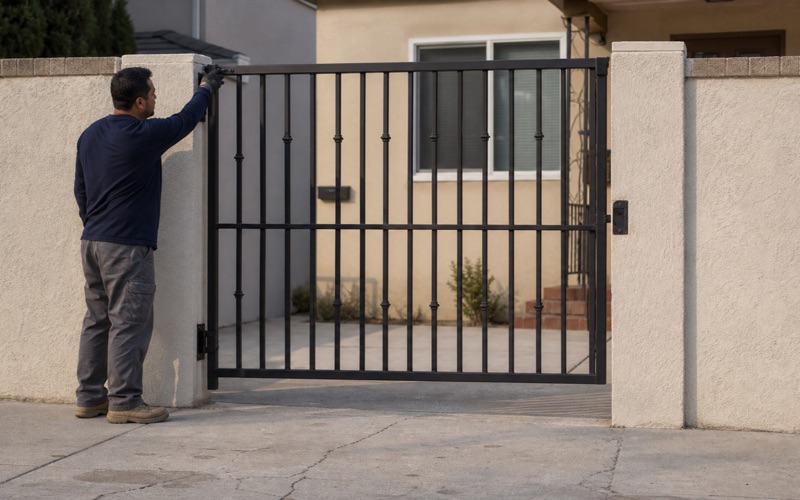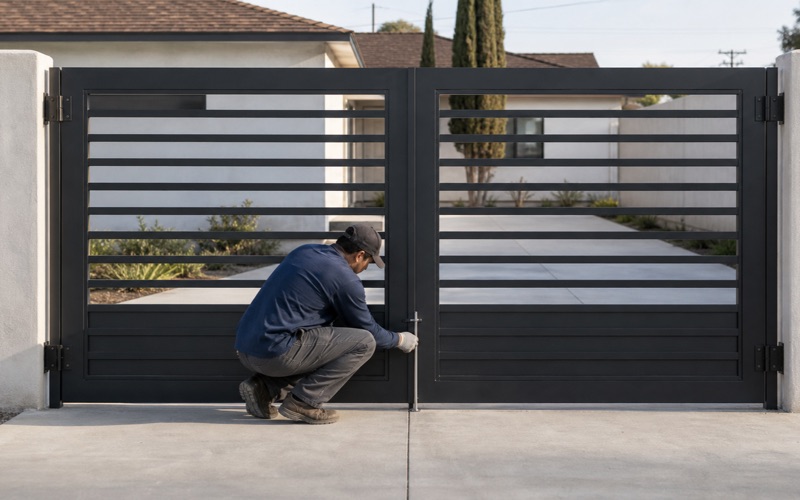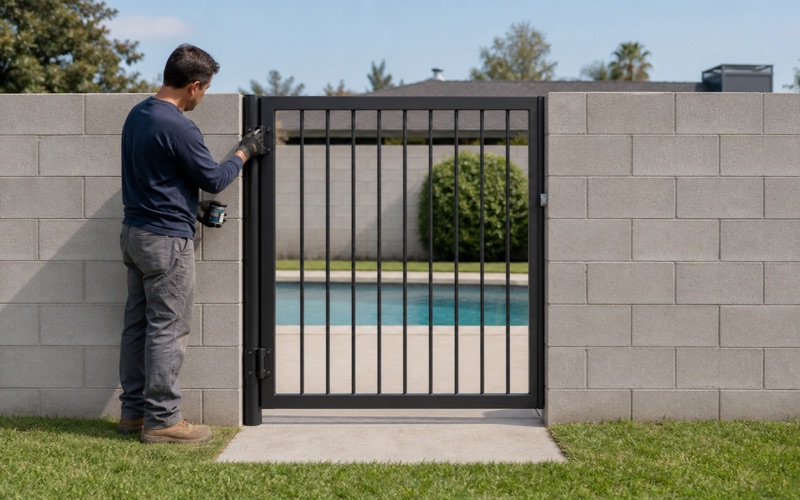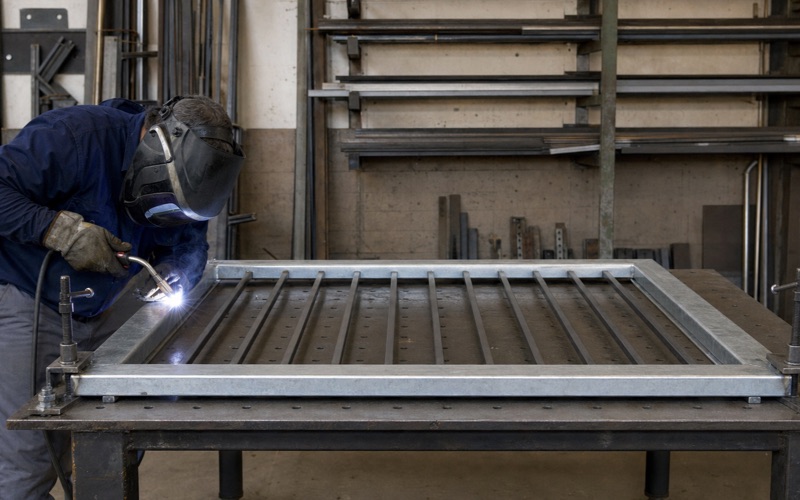
Lynwood Metal Gates builds and installs metal gates in Montebello, CA, covering driveway and entry gates, ornamental ironwork, commercial and yard gates, and repairs to gates that have started to move. Twenty years of fabricating leaves for openings across this part of the county has taught us that the thing most often left out of a gate design is the load it takes when nobody is touching it.
A gate is a sail. It is a large flat panel, fixed along one edge, standing in the open, and every square foot of it that the air cannot pass through is surface for the wind to push on. That force does not arrive gently. It arrives as gusts, repeatedly, from whichever direction the street channels it, and it is carried entirely by two hinges and a post.
Most people never think about this, and on a modest open picket gate they never need to. It becomes decisive the moment somebody asks for privacy, because a solid infill can multiply the load on the same frame several times over without changing the gate’s dimensions at all.
Wind, Infill and Leaf Area
Why Solid Infill Changes Everything
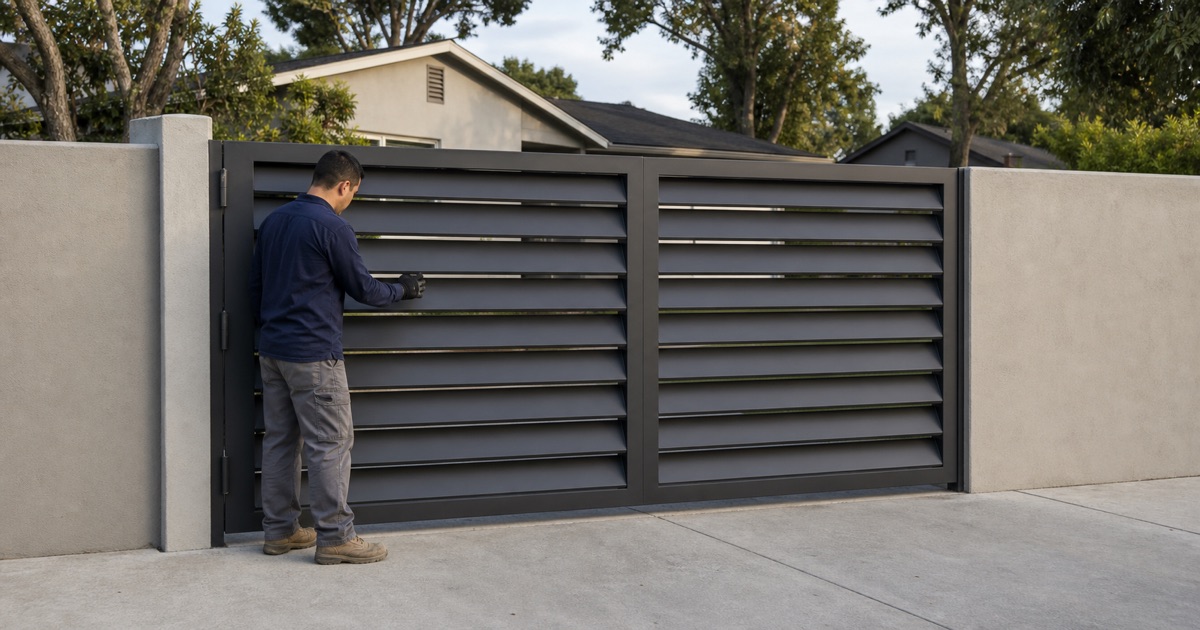
An open picket gate lets most of the air through and takes comparatively little load. Fill the same frame with sheet, close-boarded slats or a privacy panel and the wind now has the whole area to push against. The frame section, the hinges, the post and the footing all have to grow to match, and none of that is visible in a drawing that only shows the elevation.
Getting Privacy Without the Full Load
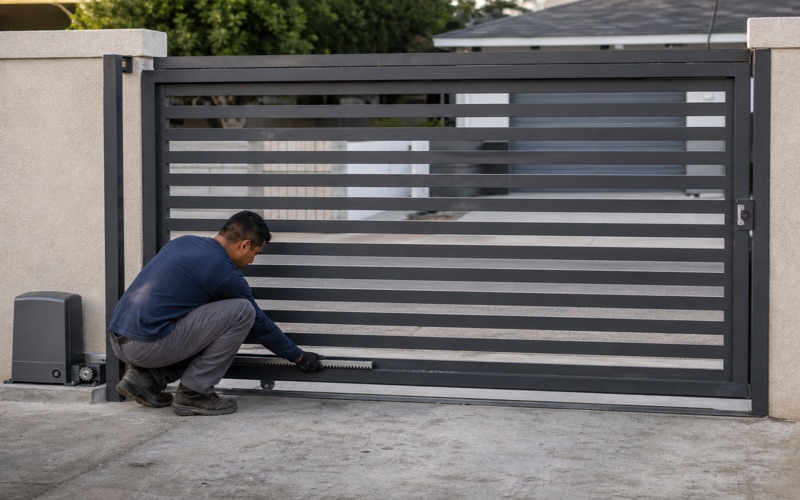
There is a middle ground, and it is usually the right answer. Overlapping slats set with a gap, angled louvres, or perforated infill will block the sightline from the street while still letting a meaningful share of the air through. It costs a little more to fabricate than a flat sheet and it saves considerably more in hinges, post and footing, as well as producing a gate that does not slam.
Sizing the Hardware to the Real Load
We calculate leaf weight from the finished material list and consider the exposed area alongside it, then size ball-bearing hinges with grease fittings, the latch and the drop rod against both. A hinge chosen for static weight alone will handle a gate perfectly well until the first sustained gust, which is when the fixings start to work loose. The sizing is recorded in the job file so a later repair starts from the number.
Looking for metal gates closer to Hawthorne? See Metal Gates in Hawthorne.
A City That Has Seen Real Wind
The 2023 Tornado
Montebello is one of very few cities in this region with a documented reason to take this seriously. In March 2023 it was struck by an EF1 tornado, the strongest to hit the Los Angeles metropolitan area since 1983. Events like that are rare enough that no gate is designed for them specifically, but they are a useful reminder that the assumption behind a lot of gate hardware, which is that wind here is never a structural issue, is an assumption rather than a fact.
Designing for the Ordinary Case, Robustly
What that means in practice is not over-engineering for an extreme, but not sizing hardware to the bare minimum either. A gate specified with some margin costs a small amount more once and absorbs gusts, an accidental push from a vehicle and years of ordinary use without loosening. A gate specified with none is fine until it is not.
Automated Gates and Wind
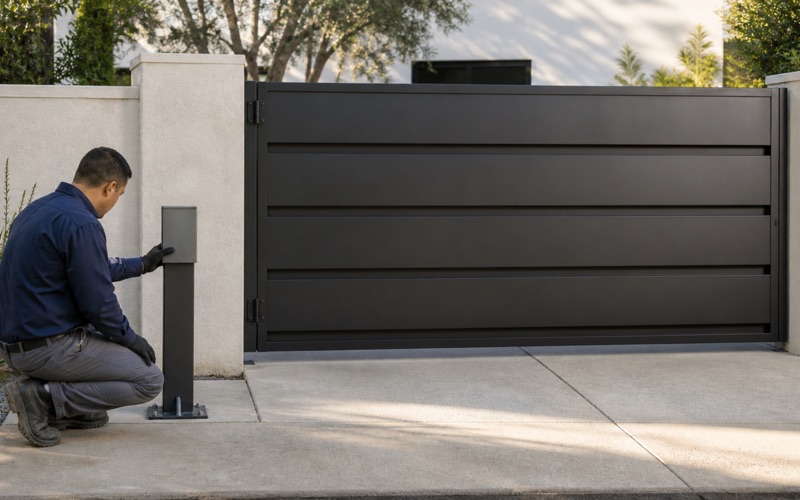
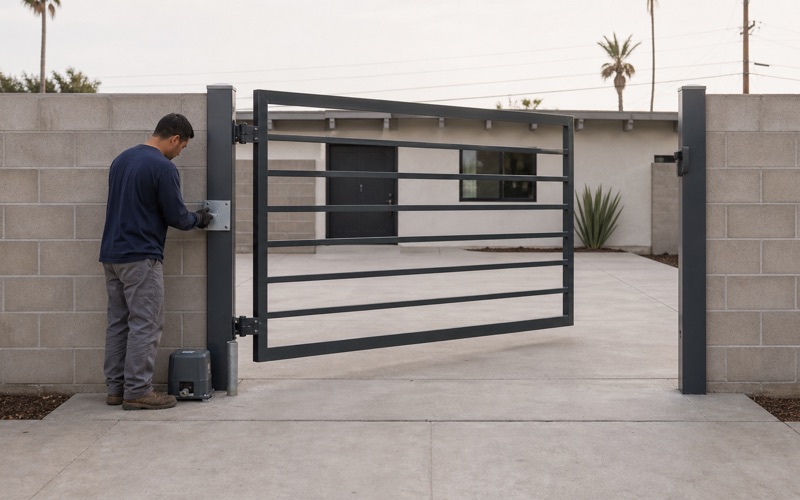
An operator adds a further consideration, because a powered gate cannot yield to a gust the way a free-swinging leaf can. The motor holds the leaf against the load, and on a large solid gate that shows up as an operator working far harder than its rating suggests. Where a customer wants both privacy and automation, the infill choice becomes an operator-sizing decision rather than an aesthetic one.
Posts and Footings Under a Loaded Gate
Wind load does not stop at the hinge. It travels into the post and then into the footing as a rotating force, which is why a post that was adequate for a light gate starts to lean once a heavier or more solid leaf goes on the same fixing. On any gate with real exposed area we increase the footing rather than only the hardware, and we leave the excavation open for inspection before the pour. A post that has rotated even slightly cannot be corrected by adjusting the gate.
Ornamental and Entry Gates
Detailing That Reduces Load While Adding Interest
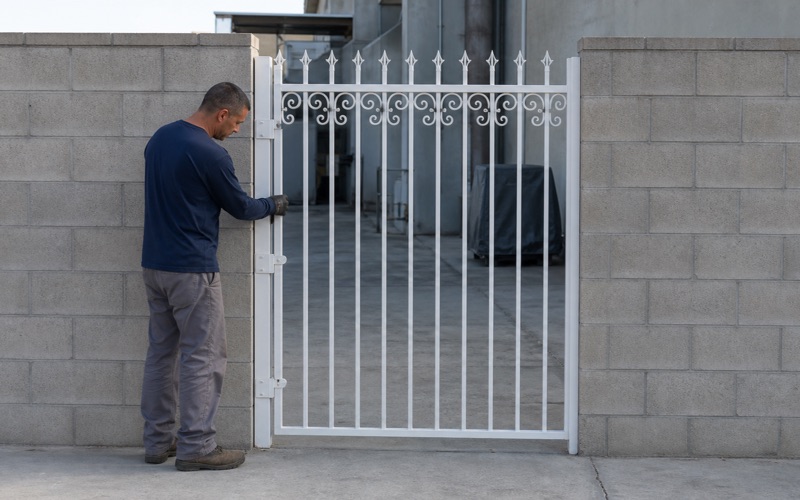
The useful thing about ornamental ironwork is that it is mostly air. Scrollwork, spear tops, panelled infill and varied picket spacing all add visual weight without adding much exposed area, which makes them the natural way to give a gate presence on a frontage that catches the wind. A well-detailed iron gate can look more substantial than a solid one while loading its hinges far less.
Matching a House Rather Than a Catalogue
Montebello has a long history, taking its present name in 1920 and holding sites that go back much further, including the Juan Matias Sanchez Adobe and the battlefield of the Battle of Río San Gabriel. The building stock that resulted is varied, and a gate that suits one street can look imported on the next. We draw against an elevation of the actual house rather than choosing from a range.
Finish for Sun and Exposure
An exposed gate takes more sun and more airborne grit than a sheltered one, and both attack a coating. Welds are dressed and inspected, zinc-rich primer goes onto the joints, and TGIC polyester powder coating goes over the whole leaf, with hot-dip galvanizing underneath where the exposure justifies it. Coating over an undressed weld looks identical on the day and fails from beneath.
Latches, Stops and Slamming
A gate that slams in the wind destroys itself slowly, and it does it at the latch and the hinge fixings rather than anywhere visible. Positive stops that catch the leaf before it reaches the end of its travel, a latch that engages rather than merely rests, and where appropriate a hydraulic closer to take the energy out of the swing all address it. On an automated gate the operator itself becomes the stop, which is another reason its force and limits get set deliberately rather than left at a default.
Commercial, Yard and Repair Work
Yard Gates on Exposed Frontages
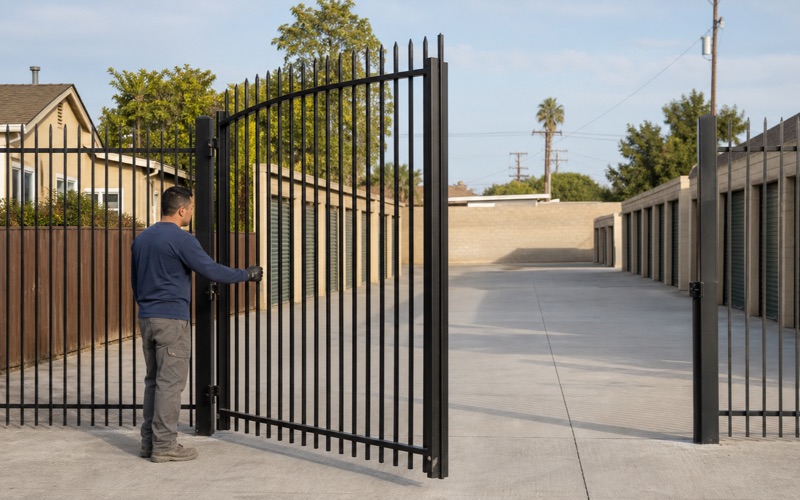
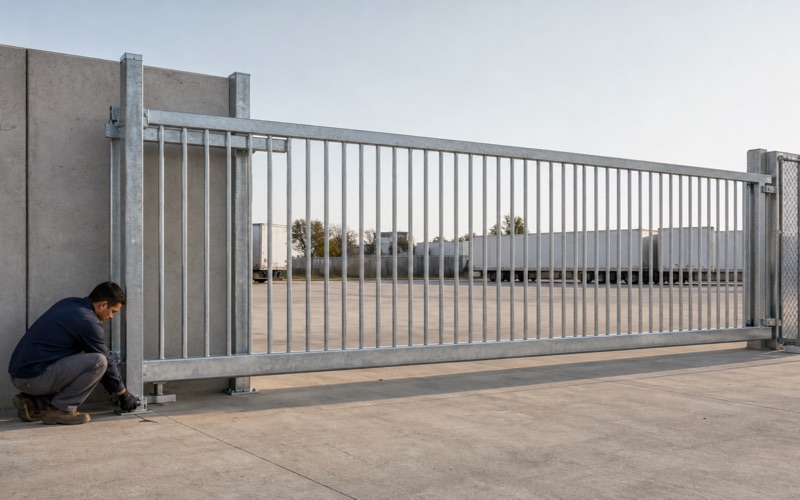
A wide commercial gate has more area than any residential leaf and is often on the most exposed part of a site. On spans like these a cantilever arrangement is frequently the better answer, because the leaf is supported on truck assemblies through its travel rather than hung from two hinges, and the load path back into the posts is more direct. We size the trucks, posts and footings against the span rather than scaling a smaller design.
What Wind Damage Looks Like Later
Gates rarely fail in a gust. They fail months afterwards, because the gust worked the hinge fixings loose, opened a weld, or rotated a post slightly in its footing, and everything after that is downhill. When we look at a gate that has started to drop, one of the first things we check is whether the post has moved, because repairing the leaf on a post that has rotated simply resets the clock.
Repair, Reinforcement and Knowing Which
A leaf that has been overloaded can often be reinforced in place with an additional rail or a corner gusset, which is far cheaper than replacement and keeps ironwork that suits the property. Where a member has actually yielded, we replace the section rather than pull it straight, because steel that has been bent back is weaker than it looks and will go again in the same place.
Permits, Drawings and Getting It Approved
Every City on This Side of the County Is Different
Montebello writes its own fence and gate provisions, and they are not Lynwood’s or any other neighbour’s. Height limits, permitted materials, what may sit in a front setback and how a gate may relate to a sidewalk all vary genuinely across a city line, sometimes by a substantial margin. We confirm the requirements of the city the gate is actually going in rather than carrying a familiar figure across the boundary, because a rule that is correct two miles away is worth nothing at an inspection.
The Drawing Comes Before the Steel
Nothing gets cut until a dimensioned drawing has been agreed showing leaf sizes, infill spacing, rail positions, hardware locations and how the gate meets its posts. That drawing is what a permit application needs as an elevation, and it is also the cheapest place to change your mind. Moving a line on paper costs nothing; moving a welded member in a finished frame costs a day and generally shows afterwards.
Inspection, and What Gets Left Open
Where a footing is inspectable we leave the excavation open until it has been seen rather than backfilling and hoping. On a gate with real exposed area that footing is carrying a rotating load every time the wind blows, so it is the last part of the job anybody should be taking on trust. The measured opening, the calculated leaf weight and the hardware sizing all go into a written record that is handed over with the gate, which is what makes it maintainable by whoever looks after the property next.
- 20+ Years in the Trade
- Free On-Site Measure
- Permit Work Handled