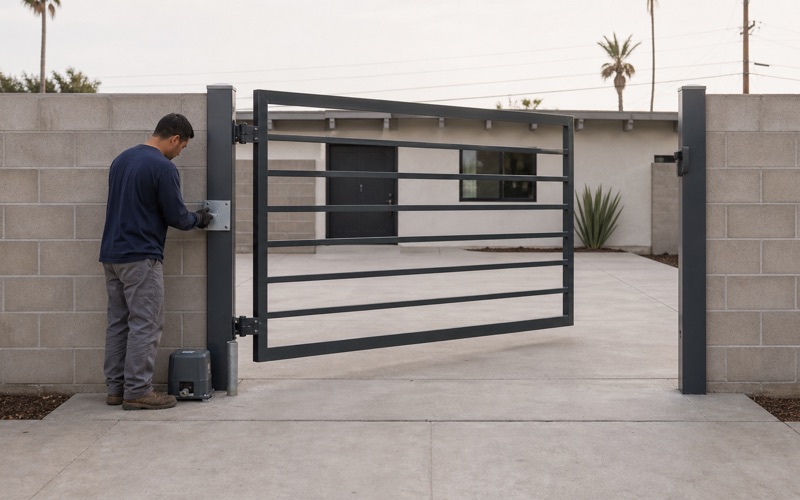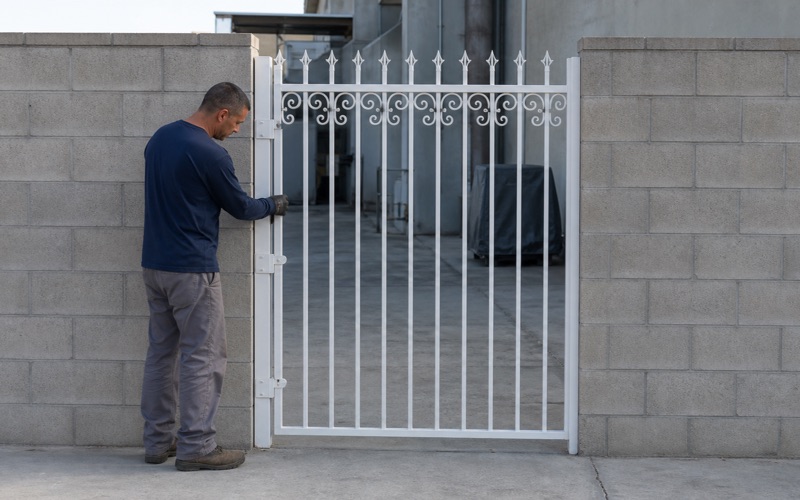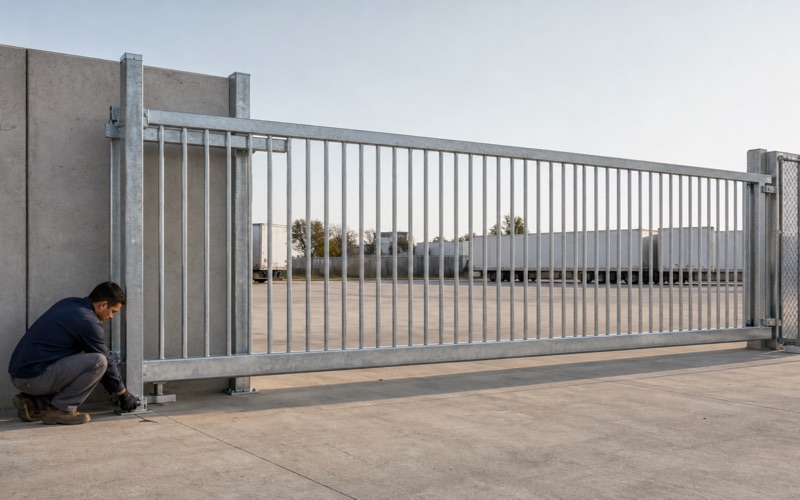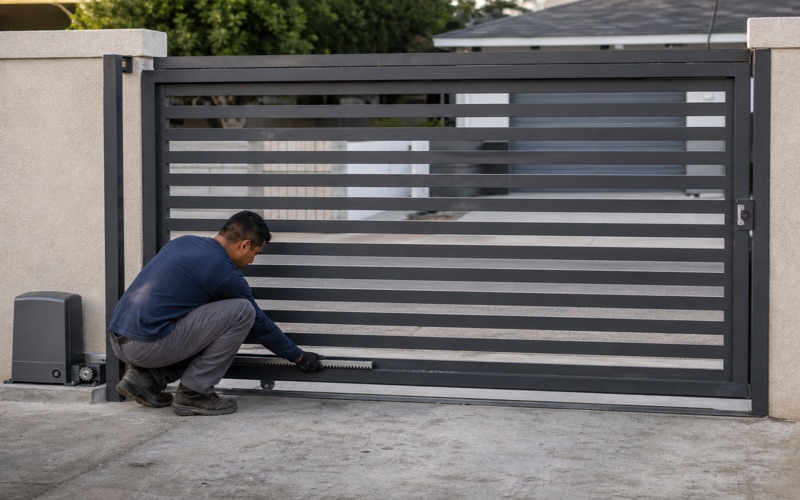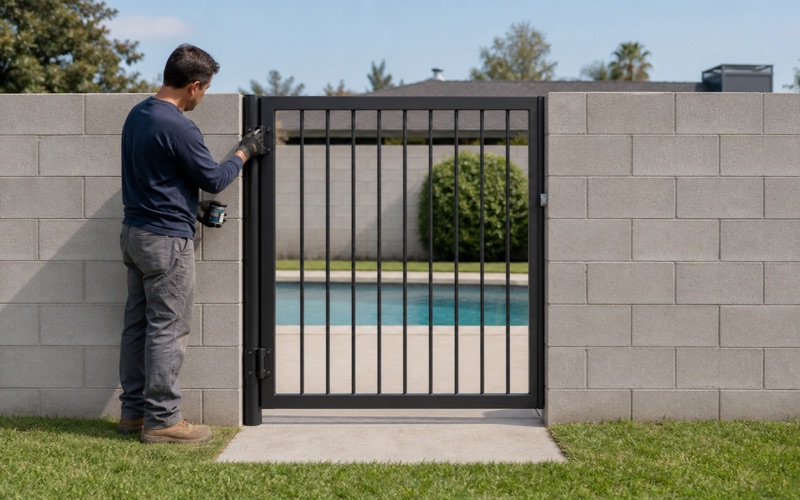
Lynwood Metal Gates builds and installs metal gates in Manhattan Beach, CA, covering driveway and entry gates, pedestrian and courtyard gates, ornamental ironwork and automation. Twenty years of setting gate posts across this county means we treat one question here as the first question rather than a detail near the end: what the post is actually going into.
A gate post is not holding a weight down. It is resisting a rotation. The leaf hangs off one side of it and tries to turn it over, every time the gate is opened, every time somebody leans on it, and continuously whenever the wind pushes on the panel. What resists that is not the concrete itself but the ground the concrete bears against.
That is why a footing detail which is entirely adequate a few miles inland can be inadequate here. Manhattan Beach was originally sand dunes, levelled through the 1920s and 1930s by the Kuhn Brothers Construction Company, with the excess sand shipped away to Waikiki. A great deal of the city is built on what is left, and clean sand behaves very differently from the soils a standard footing assumes.
Footings in Sand
Why Sand Is a Different Problem
Clean, dry sand has effectively no cohesion. It does not grip a footing the way a clay or a loam does, and it will flow around and away from a load rather than resisting it in place. A standard narrow hole filled with concrete gives a gate post very little to bear against laterally, which is precisely the direction the load is coming from. The post does not sink; it slowly rotates, and the gate drops at the latch.
Geometry Rather Than Depth Alone
The answer in sand is usually not simply a deeper hole but a wider one, because lateral resistance comes from the area of footing bearing against the ground rather than from how far down it goes. A belled or stepped footing that presents a larger face to the direction of load will hold where a narrow cylinder of the same volume will not. We size the footing against the calculated leaf weight and its exposed area rather than reaching for a standard detail.
Keeping the Excavation Open
Sand does not hold a clean excavation, and a hole that has partly collapsed before the pour produces a footing that is a different shape from the one specified. We form or case where necessary, and we leave the excavation open for inspection before any concrete goes in, because once it is poured and backfilled nobody can tell what shape it actually is. On the one element that cannot be corrected afterwards, that is worth the extra visit.
Drainage and What Moves Underneath
Sand drains freely, which is helpful in that water does not sit against a footing, and unhelpful in that water moving through it can carry fine material away over time. Where a downpipe, a drive fall or an irrigation line discharges near a gate post we redirect it, because a footing that was perfectly adequate can be undermined gradually by water that nobody would think of as a problem.
Looking for metal gates closer to San Gabriel? See San Gabriel Metal Gates.
Working on Steep, Tight Frontages
Grade Across the Arc
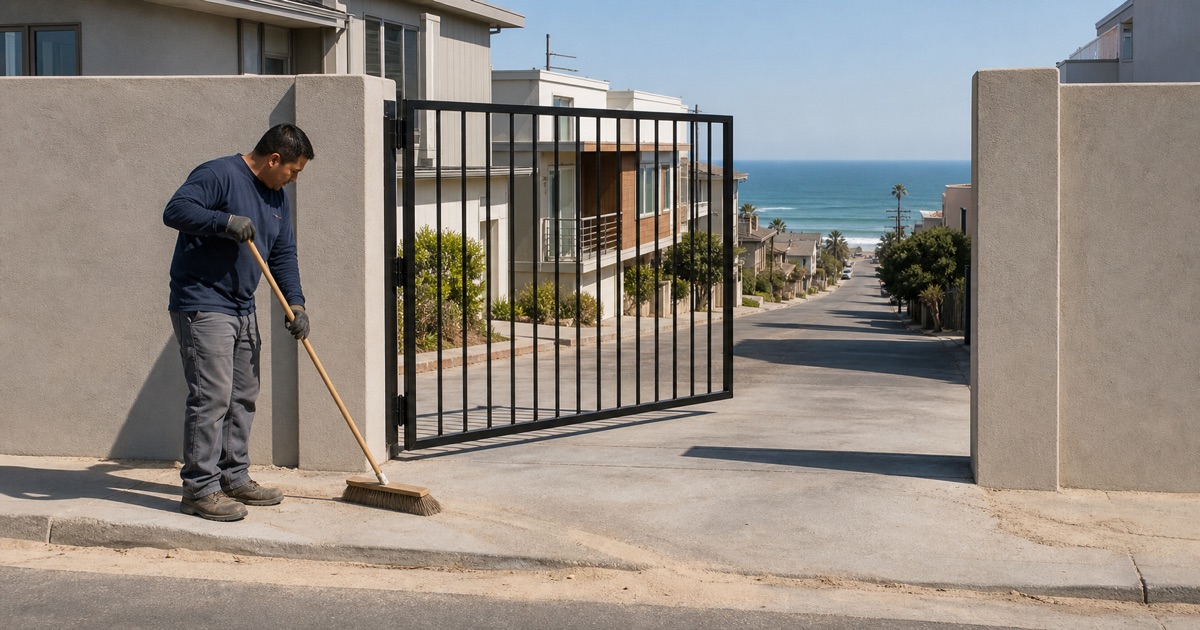
The streets running down toward the sand are steep, and a slope across the arc of a swing leaf is the single most common reason a gate binds partway through its travel. It cannot be corrected afterwards by adjusting hinges. We measure the fall across the whole arc rather than at the opening alone, and where the grade is real we design around it, either with leaves hung to clear or by moving to a sliding arrangement.
Small Lots and Where the Gate Can Go
Lots here are frequently narrow and built out close to their boundaries, which leaves very little room for a gate to open into and often no run alongside an opening for a slide. A pair of leaves halves the arc each one needs, and on the tightest frontages a gate that folds or one that opens into a recess formed for it is sometimes the only thing that works. That is a design decision taken at survey, not a fix applied later.
Getting Materials to the Job
Access is a genuine constraint on these streets: parking is limited, the approach may be steep, and there is frequently no room for anything large. We size and fabricate sections so they can be carried in and handled without heavy plant, and we plan the sequence so that the disruptive part of the work is as short as possible on a street where blocking it for a day affects a lot of people.
Material, Finish and Exposure
Close Enough to the Sea to Matter
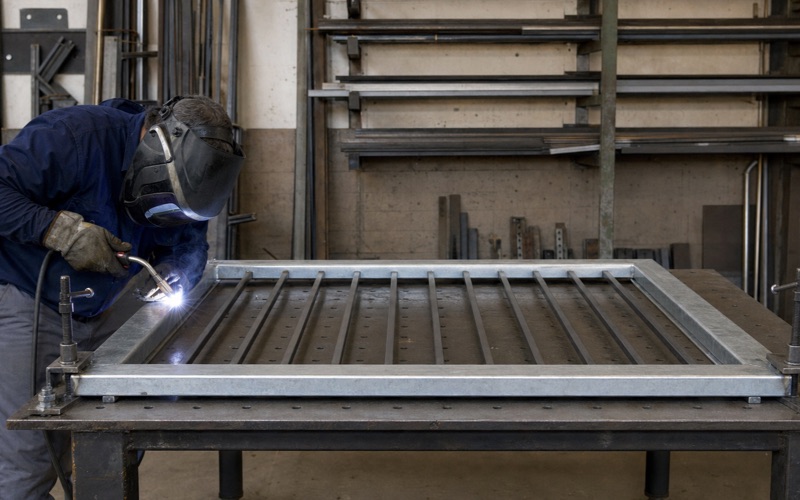
Salt in the air reaches well inland here, and it attacks the parts of a gate nobody inspects: inside unsealed hollow sections, behind hinge leaves, under washers and inside lock housings. We seal sections, dress and inspect welds, put zinc-rich primer onto every joint and a TGIC polyester powder coat over the leaf, with hot-dip galvanizing to ASTM A123 underneath on anything genuinely exposed.
Aluminium as the Low-Maintenance Answer
Aluminium extrusion in 6005-T5 or 6061-T6 does not corrode and is lighter for the same span, which also means less load into the post and the footing — a useful secondary benefit given the ground. It dents more readily than steel, so on a gate that takes vehicle or equipment contact we will usually still specify steel and protect it properly. Where nobody will maintain anything, aluminium is the honest recommendation.
Fixings and the Galvanic Question
On a well-made gate in this environment the first failure is nearly always a fastener rather than a member. Appropriately specified stainless fixings cost very little more than plated ones and last several times as long, and carelessly mixing metals at a fixing creates a galvanic problem that will outrun any coating. We specify the fasteners deliberately, because a sound leaf on corroded bolts is not a sound gate.
Design, Automation and Handover
Gates That Suit a Coastal Frontage
Much of the residential work here is about an entrance that is looked at constantly, on a frontage where the properties are close together and every detail is visible. Proportion against the building matters more than applied ornament, and open or partly open infill usually reads better on a small frontage than a solid panel, as well as loading the post considerably less.
Automation and the Load It Adds
An operator applies concentrated repeated force to the leaf, the hinges and ultimately the post, which in sand is exactly where the margin is thinnest. Where a gate is to be powered we increase the footing rather than only the hardware, size the operator from the calculated leaf weight and cycle count, and fit monitored entrapment protection as the standard requires. Retrofitting a motor to a gate whose post is already working is how a slow problem becomes a fast one.
Local Rules and the Written Record
Manhattan Beach sets its own fence and gate requirements and they are not Lynwood’s; height limits, permitted materials and setback rules differ genuinely across a city line here. We confirm the rules of the city the gate is going in. Every job is handed over with the measured opening, the leaf weight calculation, the footing detail as actually built and any commissioned operator settings, which on ground like this is the record that matters most.
Existing Gates, Movement and Repair
Reading a Gate That Has Dropped
When a gate here starts to drag, the first question is whether the post has moved rather than whether the hinges have worn. In sand it very often has, and the tell is in the gap: worn hinges give an even droop at the latch, while a rotating post opens the gap wider at the top than at the bottom and takes the whole leaf out of plumb with it. Rehanging a gate on a post that has rotated simply resets the clock, which is why so many gates here have been adjusted more than once.
Correcting the Post Rather Than the Leaf
Where the post is the problem, the honest repair is at the footing. Sometimes that means excavating and recasting to a wider or belled profile that presents a proper bearing face; sometimes a post can be braced back to a new footing set behind it. Either is more work than adjusting hinges and it is the only thing that lasts. We say plainly which of the two situations a gate is in, because the cheap fix is genuinely worthless here.
Reinforcing a Sound Leaf
A frame that has racked slightly but is otherwise sound can often be pulled back and stiffened with an additional rail or corner gussets, which keeps ironwork that suits the property and costs a fraction of new fabrication. Where a member has actually yielded, we replace that section rather than straighten it, because steel that has been bent back is weaker afterwards and goes again in the same place.
Maintenance That Fits the Environment
Hinges with grease fittings can be serviced without dismantling anything, sealed sections give water nowhere to sit, and a finish that can be made good locally beats one that has to be redone whole. On a frontage this exposed we say at handover what wants doing and roughly how often, in plain terms, on the assumption that a gate will get the least attention it can rather than the most.
- 20+ Years in the Trade
- Free On-Site Measure
- Permit Work Handled