Lynwood Metal Gates supplies and installs metal gates in Huntington Park, CA, covering security gates for commercial frontages, driveway and pedestrian gates on the residential streets, and repairs to ironwork that has been in place for decades. More than twenty years of fabricating gates in this part of the county means most of what we are asked for here is a variation on a problem we have already solved a few streets away.
Huntington Park asks a question that most of our work does not. On a newer commercial strip a security gate only has to work. Here it has to work without wrecking the look of a building that was designed in the 1930s, on a street where the architecture is the reason people walk it. Getting that wrong is easy and permanent.
So the first thing we do on a frontage here is look at what is already there: the bay widths, the reveal depth, the line of the fascia, and whether the original detailing survives. Everything about the gate follows from that rather than from a catalogue.
Security Gates for a Period Shopfront
Scissor and Side-Folding Gates on Glazed Frontage
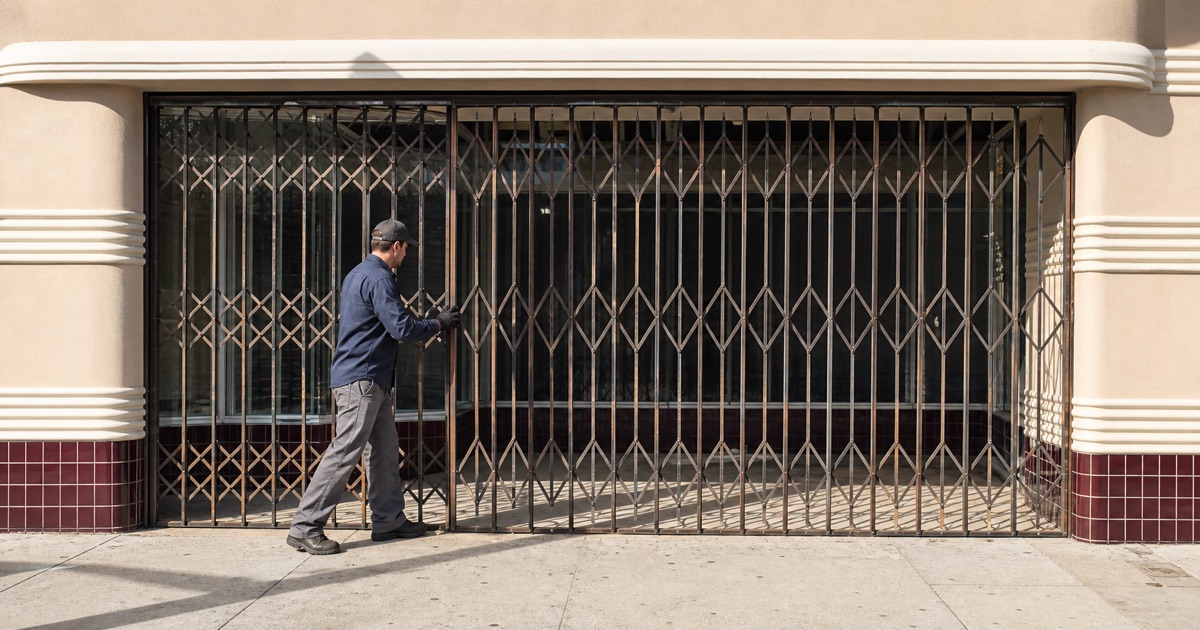
A scissor or side-folding gate is usually the right answer where the window display is the whole point of the shop, because it closes the frontage after hours and folds back clear of the glass during trading. The design question is always where the stack sits when the gate is open. A stack covering a third of the window has solved the security problem by creating a retail one, so we survey the reveal and look for a return wall or a recess the gate can park into.
Rolling Steel Where the Display Is Not the Point
On a service opening, a loading bay or a unit where nothing needs to be seen through the glass, a roll-up rolling steel door closes the opening outright and takes far more abuse than a lattice gate will. Head clearance decides whether it is possible: the barrel and housing need real room above the opening. Retrofitting one into a finished frontage is where the cost hides, so we check the head and the guide runs before quoting rather than after.
Keeping the Hardware Off the Facade
The detail that most often ruins a period frontage is not the gate but its fixings: a track screwed across a moulding, a housing bolted over a tiled stall riser. Where a frontage still has its original material we set the guides into the reveal and take fixings into the structure behind rather than through the face. It takes longer and it is the difference between a shop that looks secured and one that looks damaged.
Window Guards and Fixed Grilles
Not every opening needs a moving gate. On a rear elevation, a light well or a unit with a secondary window, a fixed grille does the same job with no mechanism to maintain and no stack to find room for. The design question is escape rather than security: any grille on an opening that could be an emergency exit has to be releasable from inside, and that has to be designed in rather than added as an afterthought. We build these to match the frontage ironwork so a building reads as one thing rather than as a shop with bars on the back.
Looking for metal gates closer to Maywood? See Metal Gates Services in Maywood.
Ironwork That Suits the Street
Reading the Building Before Drawing the Gate
Pacific Boulevard was the city’s main shopping street through the middle of the last century, and much of what was built along it is Art Deco and Streamline Moderne. Those styles have a specific vocabulary: horizontal emphasis, stepped and banded detail, curves at the corners, and very little of the scrollwork people associate with ornamental iron. A gate covered in scrolls fights a Moderne facade rather than complementing it.
Detailing That Belongs to the Period
Where a gate is going onto a building of that era we work in horizontal bands, stepped rails and simple repeated verticals, and we let the proportions carry the design rather than applied ornament. It is usually cheaper to make than a scrolled equivalent, and it reads as though it was always meant to be there. On a plain postwar infill building between two older ones, a simpler gate again is the honest answer.
Finish and How It Weathers on a Busy Street
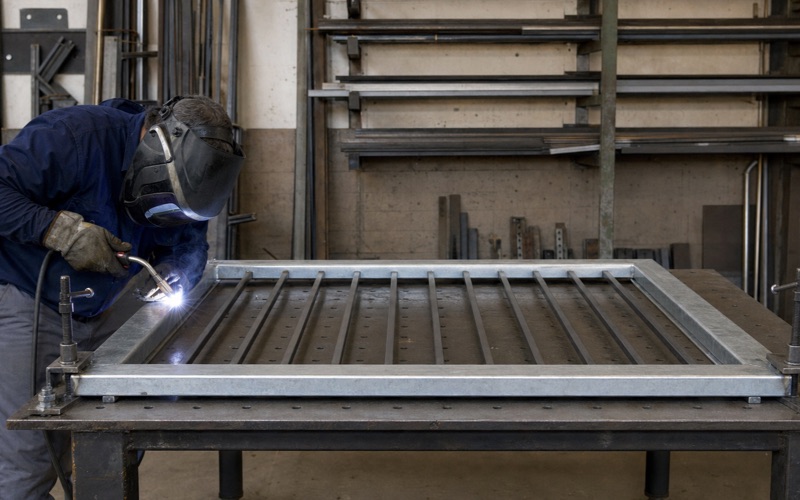
A commercial frontage on a heavily used street collects traffic film and gets touched constantly, so the coating has to be prepared properly rather than sprayed over mill scale. Welds are dressed back and inspected, zinc-rich primer goes onto the joints, and a TGIC polyester powder coat goes over the whole assembly. On a gate that will be opened and closed twice a day for years, that sequence is what decides whether it still looks maintained in a decade.
Repairing Original Work Instead of Replacing It
A good deal of the ironwork on this street is decades old and structurally sound under a poor coating, and stripping and recoating it is a fraction of the cost of replacement. We assess the frame corners and the section thickness first, because those are what decide whether a piece is worth saving. Where a single member has corroded through, it is cut out and let in rather than the whole assembly being scrapped, which keeps detailing that would be expensive to reproduce and is often no longer available.
Gates on the Streets Behind
Driveway Gates on Narrow Frontages
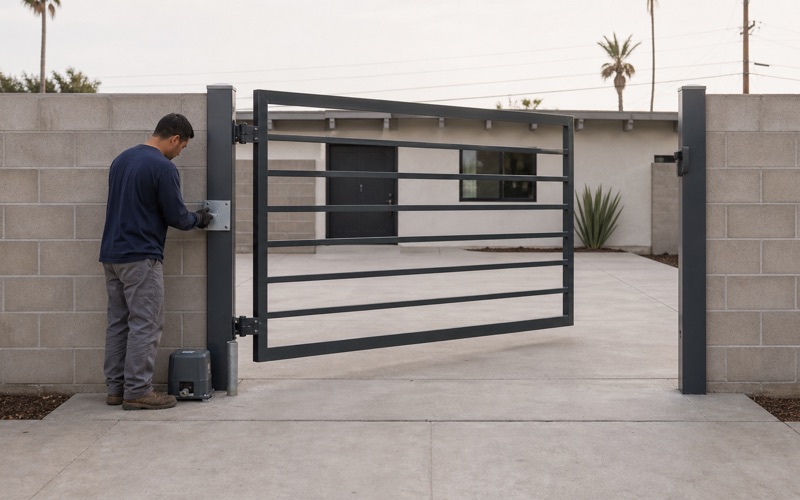
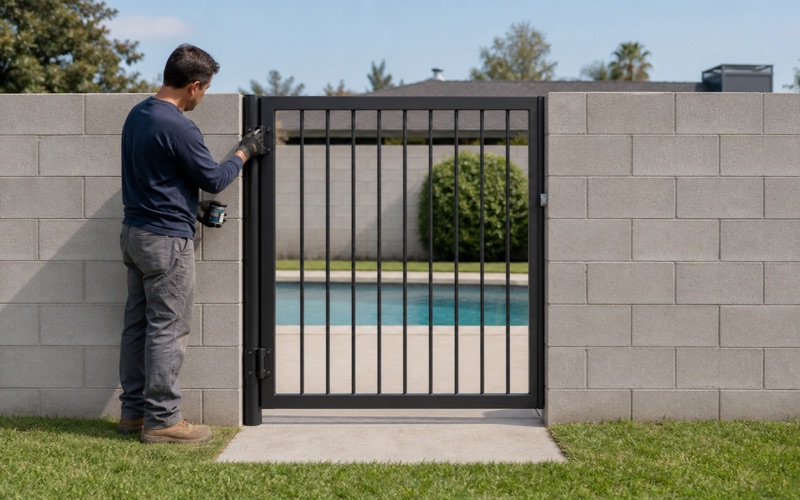
Huntington Park was laid out as a streetcar suburb and the residential lots reflect it: narrow frontages, short driveways, and very little room between the sidewalk and the house. That combination rules out a lot of standard gate arrangements. A pair of leaves rather than a single is usually the answer, because it halves the arc each one needs and halves the cantilevered load on its hinges at the same time.
Where a Slide Gate Beats a Swing
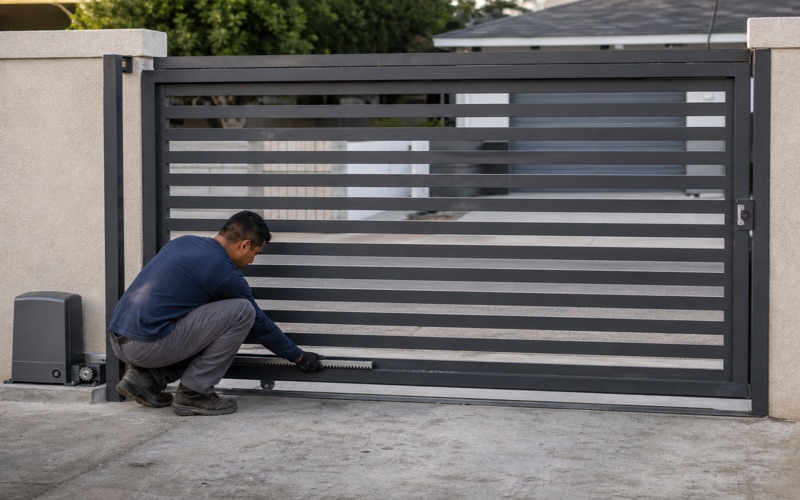
On the tightest of these frontages there is genuinely no arc available, and a sliding gate running alongside the opening is the only thing that will work. It needs backrun roughly equal to the clear opening, which on a narrow lot usually means running along the front of the house rather than down the side. We measure that run before proposing it rather than discovering afterwards that a downpipe is in the way.
Matching an Older Iron Fence Run
A great deal of the residential ironwork here went in decades ago and is still sound, so a replacement gate usually has to match a fence run rather than start fresh. We take the picket dimensions, spacing, rail depths and any finial detail off the existing work and reproduce them, which is far more convincing than a catalogue design that is merely close. Where the original detail no longer meets the current spacing rules, we say so rather than copying a non-compliance forward.
Pedestrian Gates That Take Daily Traffic
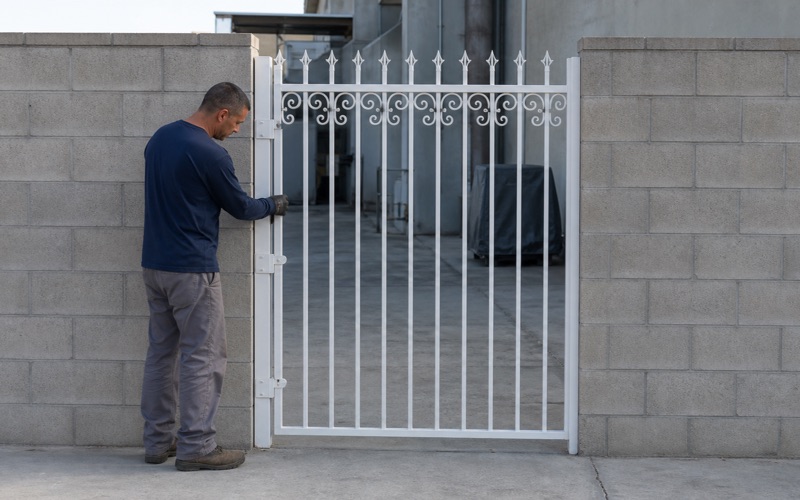
A side or courtyard gate on these blocks gets opened many times a day, which is a completely different duty from a driveway gate used twice. That shows up first at the hinge and then at the latch, so we build them heavier than their size suggests and fit hardware sized well above the leaf weight. A small gate that is used constantly and built lightly is the one we are most often called back to, and it is the cheapest thing on a property to get right the first time.
Working on a Live Frontage
Codes Differ From One City to the Next
Huntington Park has its own fence and gate provisions, and they are not Lynwood’s. We check the requirements of the city the gate is actually going in, because height limits, permitted materials and setback rules vary between neighbouring cities in ways that surprise people. Assuming a rule carries across a city line is one of the more expensive mistakes available on this kind of work.
Encroachment Over the Sidewalk
On a commercial frontage with no setback, anything that projects over the public sidewalk is an encroachment question rather than a design one, and it needs the local authority’s permission. That is worth settling before fabrication, because the alternative is a finished gate that cannot legally be hung the way it was drawn. On a tight frontage it is usually simpler to design the movement inside the property line.
Installing Without Closing the Business
The practical constraint on a working shop is that it has to keep trading. We measure and fabricate off site so the disruptive part of the job is hours rather than days, and where an opening has to be left insecure overnight we say so in advance rather than at five o’clock. On a street where the businesses serve the neighbourhood directly, a day lost is a real cost rather than an inconvenience.
A Written Record That Outlives the Install
Every opening we work on gets a written measurement record covering widths, grades and fixing positions, handed over with the finished gate. On a commercial property that changes hands or changes tenant, that record is often the only surviving description of what was actually built, and it is what makes a repair years later a straightforward job rather than a survey from scratch.
- 20+ Years in the Trade
- Free On-Site Measure
- Permit Work Handled