Lynwood Metal Gates installs and services metal gates in Hawthorne, CA, across industrial and commercial sites, airport-adjacent property, and the residential streets in between. Twenty years of building vehicle gates in this county means we are used to the requirement that shows up here more than anywhere else nearby: a gate that has to control who passes through it, not merely stop them.
Those are different problems. A boundary gate has to be hard to get past. A controlled-access gate has to be easy to get through for the right vehicle, at the right time, with a record of it, and impossible for everything else — and it has to do that hundreds of times a week without becoming the thing everybody works around.
Hawthorne has a lot of property in the second category, so much of our work here starts with a conversation about traffic rather than about steel: who arrives, in what, how often, and who decides.
Gates on Aviation-Adjacent Property
Where the Boundary Actually Matters
Hawthorne Municipal Airport sits inside the city, with a Tesla design centre on it, and Los Angeles International is about five miles away. Property near an active airfield brings a boundary condition most commercial sites do not have: the line between the public or landside part of a site and the operational side is a genuine control point rather than a convenience, and the gate on it is expected to hold that distinction reliably.
Vehicle Gates That Have to Close Behind You
On a controlled boundary the requirement people underestimate is closing, not opening. A gate that opens promptly and then sits open while a driver finds a parking spot has not controlled anything. That is a specification problem: the timing, the vehicle detection and where the safety loops sit all have to be set so the gate closes behind one vehicle rather than staying open for whatever follows it.
Sensing That Distinguishes Vehicle From Person
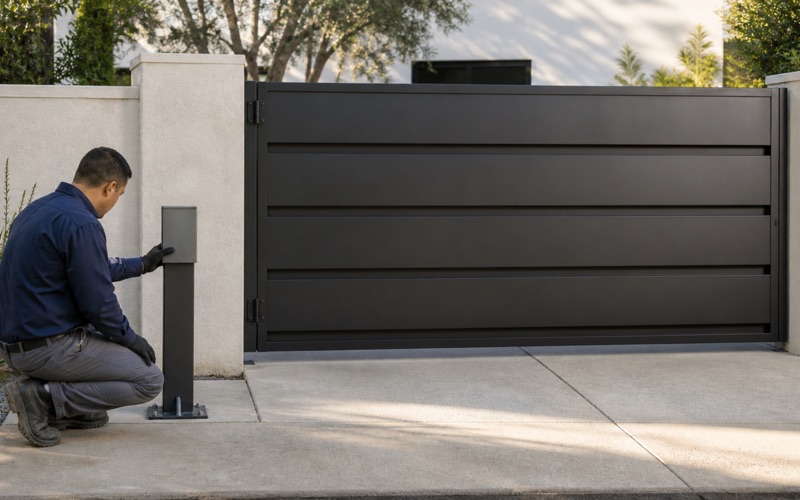
Inductive loop detectors read a vehicle by its effect on a magnetic field and are entirely blind to a person on foot, which is exactly why UL 325 requires monitored external entrapment protection alongside them. Photo eyes and safety edges cover what the loops cannot see. On a site with mixed foot and vehicle traffic through the same opening, getting that combination right is the difference between a safe gate and a fast one.
Looking for metal gates closer to Lawndale? See Metal Gates Services in Lawndale.
Industrial and Logistics Frontages
Cantilever Gates for Yards and Loading
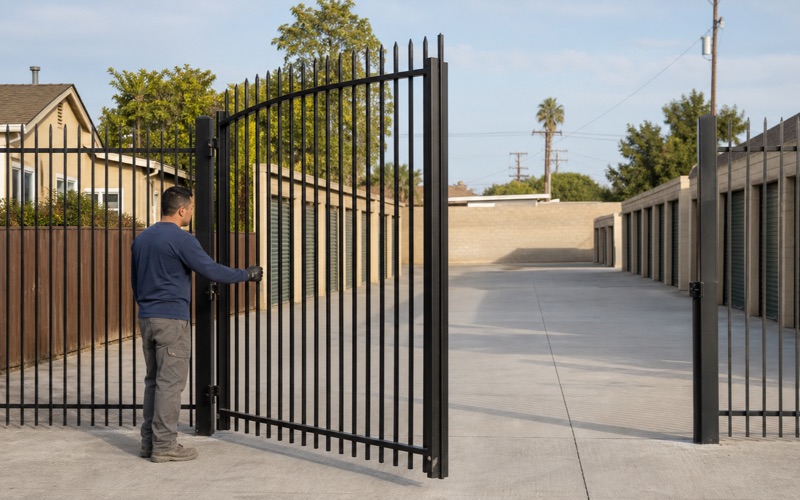
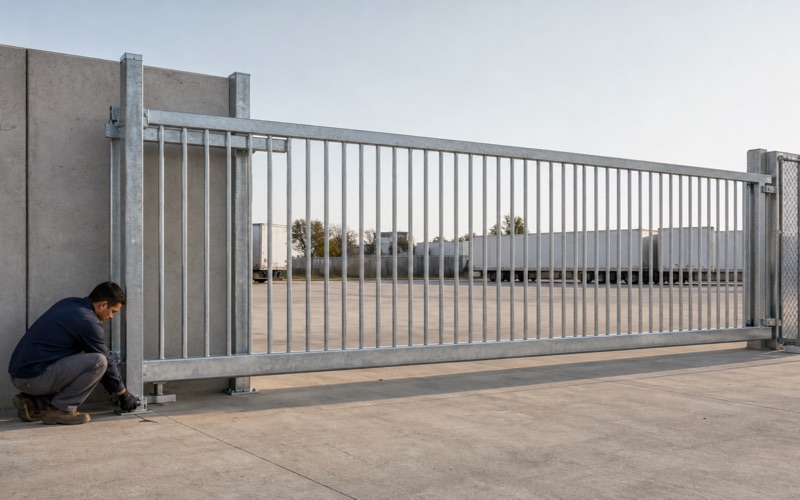
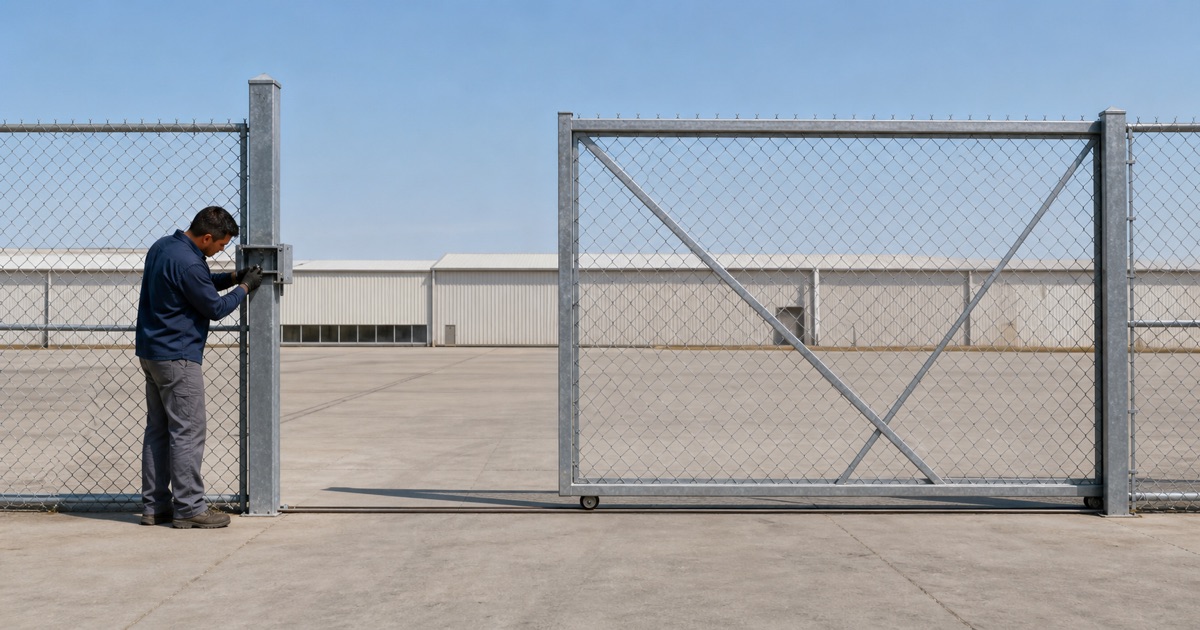
Hawthorne carries substantial industrial employment, including a large fulfilment operation and the former Northrop plant that is now SpaceX’s headquarters, and yard entrances on sites of that kind take constant heavy vehicle traffic. A cantilever slide gate suits them because the leaf runs on truck assemblies behind the opening and never touches a surface that trailers have chewed up. We size the counterbalance and check the available backrun before proposing one.
Duty Rating, Not Gate Size
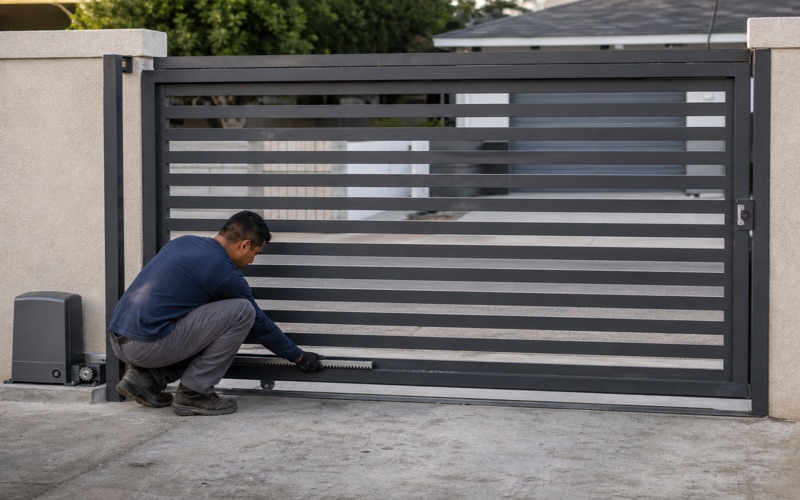
An entrance passing several hundred vehicles a day needs an operator chosen on cycle count rather than on leaf weight. UL 325 sorts operators from Class I for a single residence through to Class IV for restricted-access industrial use, and a unit specified on force alone but run far beyond its intended duty will fail on a predictable schedule. We count the real traffic, including the shift changes and deliveries people forget to mention.
Serviceability as a Requirement
On a site where the gate is production equipment, the specification question is not only how well a component performs but how quickly it can be replaced. We favour operators from LiftMaster, DoorKing, HySecurity and FAAC partly for availability, keep common wear parts to hand, and leave the force, limit and reversing settings written down at handover so a future call-out does not start from nothing.
Queuing, Stacking and Where Vehicles Wait
The commonest design failure on a busy vehicle entrance is not the gate but the space in front of it. If a vehicle waiting for the gate has to stop across a public road, the gate has created a traffic problem, and drivers respond by tailgating through on one opening. We look at where vehicles stack before specifying the detection, and on a constrained entrance a shadow loop covering the gateway itself stops being an optional extra and becomes the thing preventing a gate closing onto a stationary truck.
Access Control That People Will Actually Use
Credentials Rather Than a Shared Code
A single gate code that everybody knows is not access control, and on a site with contractors and shift staff it stops being meaningful within weeks. Individual credentials can be issued and revoked without inconveniencing anyone else, which matters most on exactly the sites that have real turnover. The cost is administration, so the handover has to leave someone able to manage it without calling us.
Designing Out the Workaround
Almost every defeated access system we are asked to replace was defeated socially rather than technically: a gate wedged for a delivery, a fob taped to a reader, a code written where everyone can see it. That is a design failure. If the correct route through is slower than the workaround at the busiest moment of the day, the workaround wins, so we specify around the peak rather than the average.
Emergency Access Built In
A Knox box or fire department key switch lets crews through without cutting the gate, and the California Fire Code’s fire apparatus access requirements govern the widths and clearances behind it. On an industrial site this is settled at design stage, because retrofitting emergency access to a commissioned controlled-access gate means reworking the controls as well as the ironwork.
Records, Settings and Handover
On a site with shift managers and staff turnover, the most valuable thing we leave behind is often not the gate. It is the written record: the measured opening, the calculated leaf weight, the hardware sizing, and the operator’s force, travel and reversing settings as commissioned. When a fault appears two years later and nobody remembers who installed what, that document turns a diagnostic exercise into a comparison, and it is the difference between an hour on site and half a day.
Residential Streets and Repair Work
Driveway Gates on Postwar Frontages
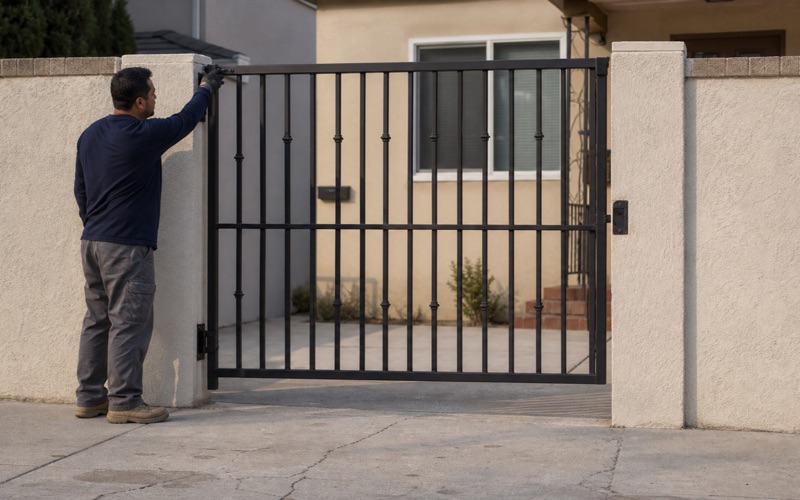
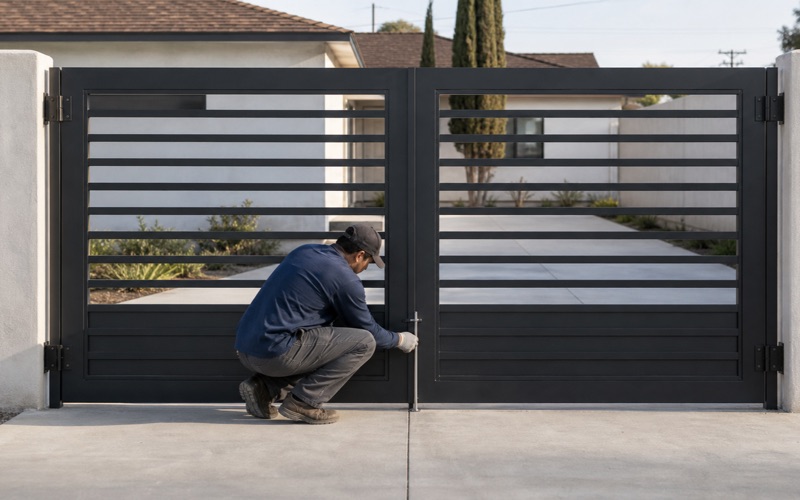
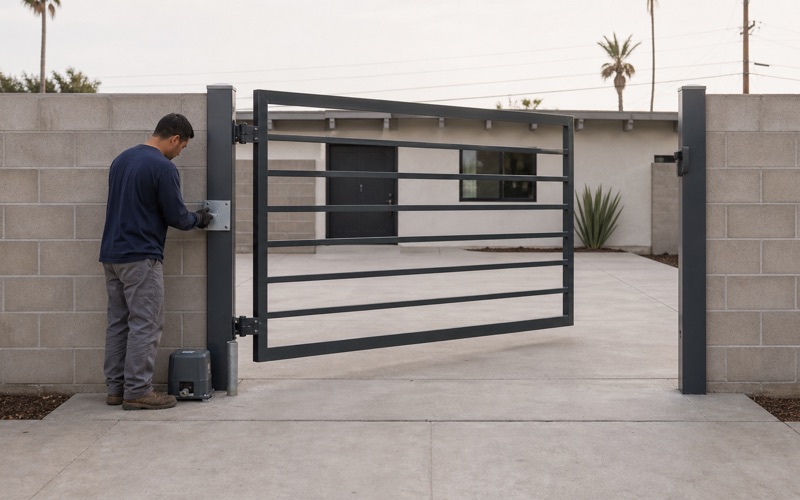
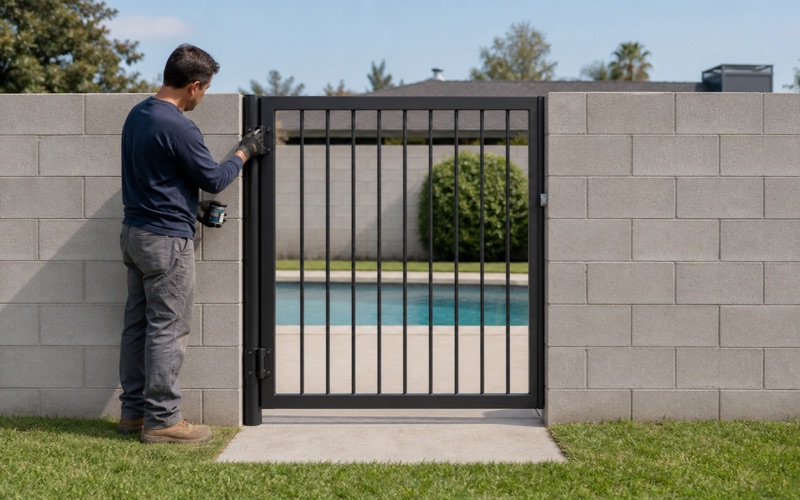
Away from the industrial parcels, Hawthorne is a dense residential city with a great deal of housing on modest frontages, much of it rented. On these the practical questions are the ordinary ones: whether there is arc for a swing leaf, whether a pair works better than a single, and whether the gate will ever be automated. We build in the provision for an operator whenever it is even a possibility, because a conduit left under a driveway costs almost nothing at the time.
Multi-Unit Entrances
A shared residential entrance cycles far more than a household gate and takes the same abuse as a commercial one, so components that are adequate on a driveway become consumables. Where we are called back repeatedly to the same part on a community gate, the answer is usually a duty mismatch rather than bad luck, and we would rather correct the specification than keep replacing it.
Local Codes, Checked Locally
Hawthorne sets its own fence and gate requirements, and they are not Lynwood’s. Height limits, permitted materials and how a gate may relate to a sidewalk vary genuinely between neighbouring cities in this county, so we confirm the rules of the city the gate is going in rather than assuming a familiar figure carries across the line.
Material, Finish and What Survives Here
Steel Where Strength Matters, Aluminium Where It Does Not
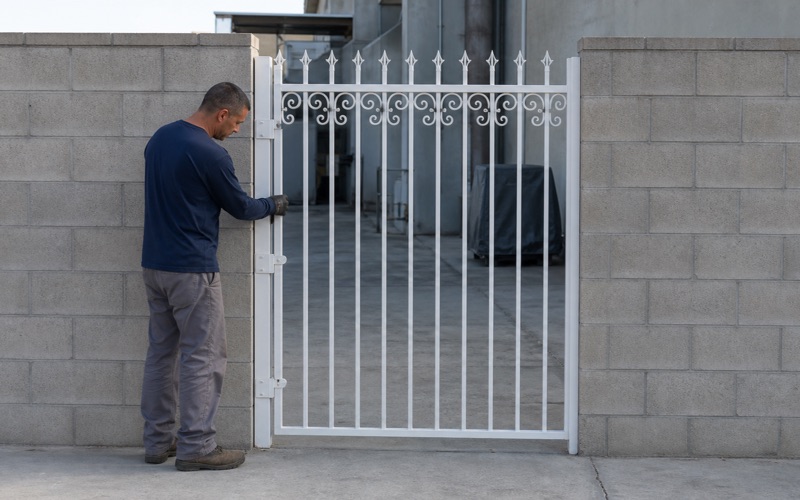
A vehicle gate on an industrial entrance is a steel job: tube to ASTM A787, welded and braced, because nothing else takes the knocks a yard entrance takes and stays straight. Aluminium extrusion in 6005-T5 or 6061-T6 earns its place on lighter pedestrian and residential leaves where corrosion resistance matters more than impact resistance, and on any gate nobody is realistically going to maintain. Hawthorne sits close enough to the coast that airborne salt is a genuine factor on an unprotected fixing, so the choice is made deliberately rather than by habit.
The Coating Sequence, in Order
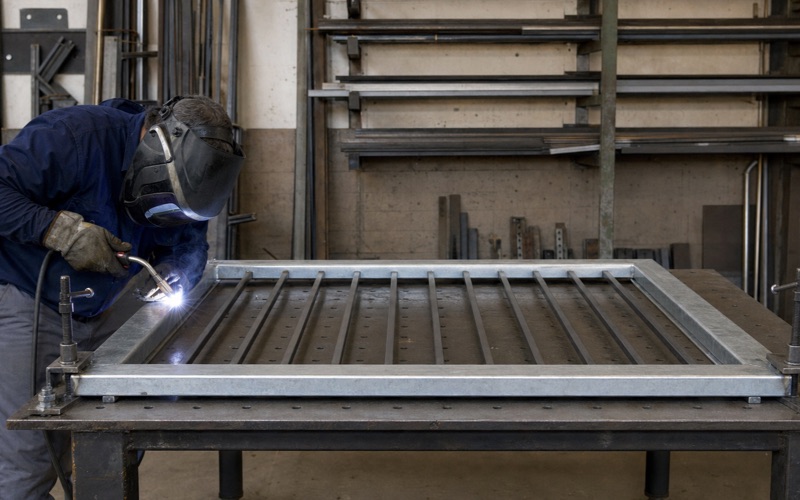
Protection is a sequence rather than a product. Welds are dressed back and inspected first, then zinc-rich primer goes onto the joints, then TGIC polyester powder coating over the whole leaf, with hot-dip galvanizing to ASTM A123 underneath on gates in genuinely exposed positions. Applied in that order the finish is protecting clean prepared steel. Applied over mill scale or an undressed weld it looks identical on the day of handover and lifts from beneath within a couple of years, usually starting at the hinge lugs where nobody is looking.
Hardware Is What Fails First
On a gate that is otherwise well built, the first thing to go is almost always a fixing rather than a member: a hinge bolt, a keep, a track fastener. Stainless or properly protected fasteners cost very little more than plated ones and last several times as long in this environment. On a powered gate we extend the same thinking to the cable runs and the enclosure glands, because water tracking down inside a conduit into a control board is one of the most common faults we are called out to, and it is entirely preventable at installation.
- 20+ Years in the Trade
- Free On-Site Measure
- Permit Work Handled