Lynwood Metal Gates designs, installs and services metal gates in Culver City, CA, covering production and studio premises, commercial frontages and residential streets. Twenty years of building controlled-access vehicle gates in this county means we are used to a requirement that is unusually common here: a gate that has to admit a stream of expected vehicles quickly, refuse everything else, and do it without becoming the bottleneck at the start of a working day.
A drive-on entrance is a genuinely demanding piece of equipment. It cycles heavily in concentrated bursts, it is watched by somebody whose job is to control it, and it sits at the point where a public street meets a site that may hold a great deal of equipment. Anything that slows it down at the busy moment gets defeated by the people using it.
It also has to be quiet, which is a requirement most commercial gates never face. On a site where sound is being recorded, an operator that clatters is a problem regardless of how well it performs on every other measure.
Drive-On and Controlled Access
Admitting a Queue Without Losing Control
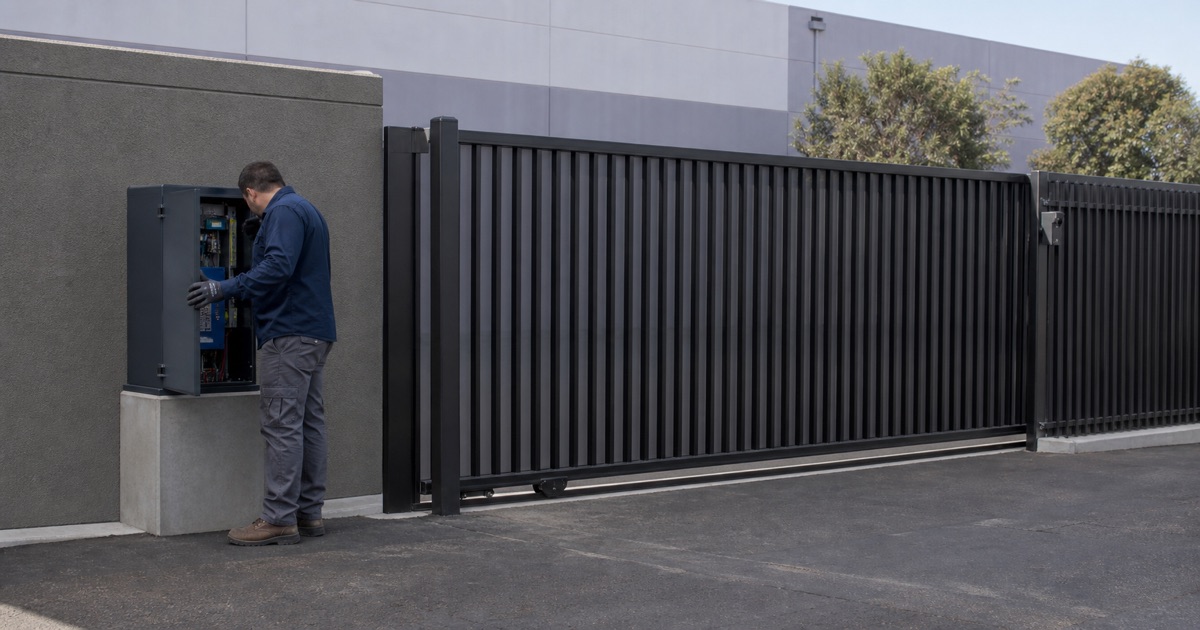
The hard case is a run of expected vehicles arriving together, each of which has to be checked. A gate that opens per vehicle and closes behind each one is secure and slow; one that stays open while a group passes is fast and controls nothing. The resolution is in the detection and the timing rather than the ironwork: vehicle sensing positioned so the gate closes behind one vehicle, with the person controlling it able to hold it open deliberately when that is the right call.
Sensing That Tells a Vehicle From a Person
Inductive loop detectors read a vehicle by its effect on a magnetic field and are entirely blind to somebody walking, which is precisely why UL 325 requires monitored external entrapment protection alongside them. Photo eyes and safety edges cover what a loop cannot see. On an entrance where crew walk through the same opening that trucks use, that combination is what separates a gate that is quick from one that is safe as well as quick.
Operating Quietly
On a site where recording happens, gate noise is a real constraint rather than a preference. Hydraulic and well-damped operators run considerably quieter than a chain drive under load, a leaf that is running true makes less noise than one being dragged, and positive stops stop a gate arriving at the end of its travel with a bang. We specify for that where it matters and say plainly what a given arrangement will sound like.
Where Vehicles Wait
The commonest failure on a busy entrance is the space in front of it rather than the gate. If a vehicle waiting has to stop across a public street, the gate has created a traffic problem, and drivers respond by following each other through on a single opening. We look at where vehicles stack before specifying detection, and on a constrained frontage a shadow loop covering the gateway is what stops a gate closing onto a stationary truck.
Looking for metal gates closer to Manhattan Beach? See Metal Gates Services in Manhattan Beach.
Production and Studio Premises
A City Built Around Its Lots
Culver City has been a production centre since Thomas Ince built the first studio here in 1918 and Hal Roach his comedy studios the following year, with the lot that MGM held for sixty-two years from 1924 now occupied by Sony Pictures. What that history leaves is a city with an unusual concentration of large walled premises whose entrances are operational equipment rather than architectural features, and which have been rebuilt repeatedly around whatever the site needed at the time.
Perimeters That Have Grown Over Time
On a site that has been extended and altered across decades, the perimeter is rarely one thing. It is a series of runs of different ages, materials and heights, joined at points nobody planned, and the gates in it are frequently the newest and the oldest elements at once. When we are asked to replace one opening we look at what it is joining, because a new gate detailed to a standard that the adjoining run cannot meet simply moves the weak point along the fence.
Stages, Compounds and Equipment Storage
Behind the main entrance there are usually secondary gates onto compounds holding equipment worth considerably more than the gate protecting it. These take a different specification: less traffic, far higher consequence, and often no supervision at all outside working hours. We build these heavier at the closure, take locks and keeps into concrete or steel rather than a surface, and detail the meeting edges so there is nothing to lever against.
Commercial and Residential Work
Frontages and Yards
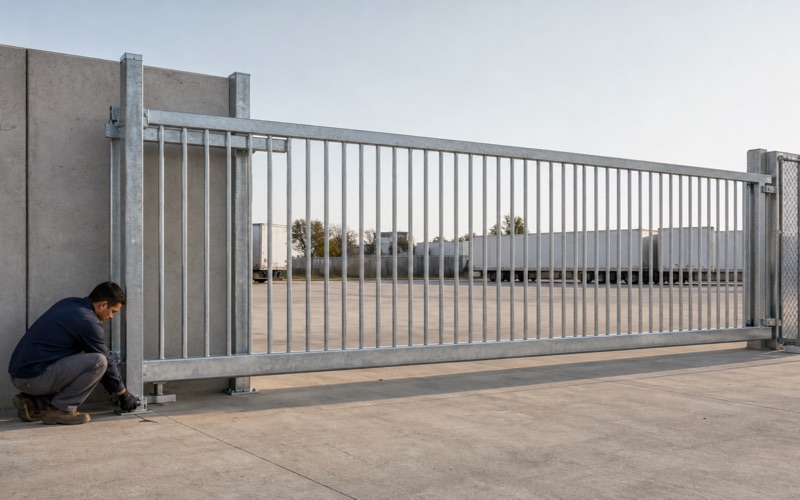
The commercial work here is the usual mix of security gates, service yard entrances and screened enclosures, and the questions are the ordinary ones: duty cycle, what the surface is like, whether a swing pair has the arc or a slide is needed, and what the local zoning requires by way of screening. Enclosure gates take daily impact from bins and equipment, so the frame is built heavier than the span alone would suggest.
Residential Gates
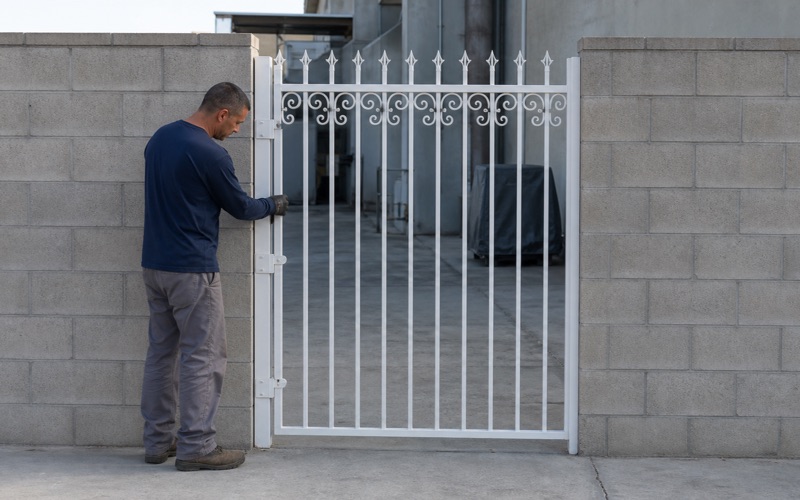
Away from the production premises this is a varied residential city, with architecture running from Mission and Colonial Revival through to the deliberately experimental work in the Hayden Tract. That range means we draw against an elevation of the actual house rather than choosing from a standard set, because a gate that suits a revival frontage looks imported next to a contemporary one, and the reverse is worse.
Automation on a Domestic Driveway
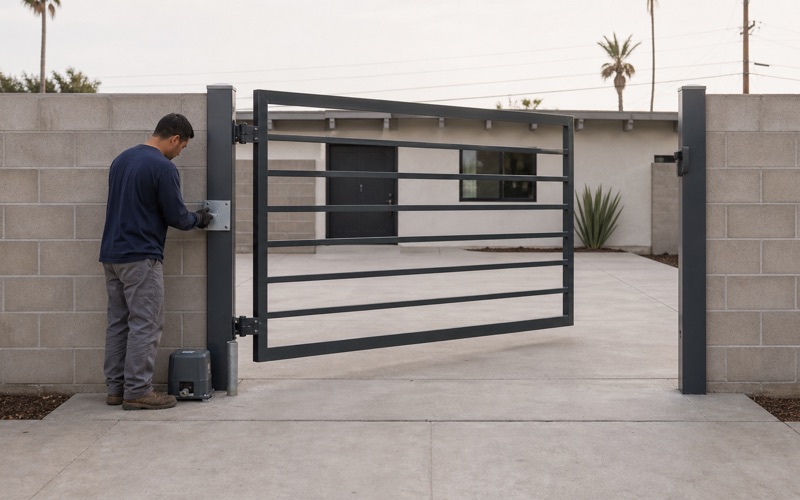
Where a household gate is powered, the operator gets sized from the calculated leaf weight and the real cycle count rather than from the opening width, with monitored entrapment protection fitted because the standard requires the operator to supervise its own safety devices. We build in the provision for automation whenever it is even a possibility, since a conduit left under a driveway costs almost nothing at the time and a great deal afterwards.
Specification and Handover
Local Rules, Checked Locally
Culver City writes its own fence and gate provisions and they are not Lynwood’s. Height limits, permitted materials, setback rules and what may project toward a public sidewalk all vary genuinely between neighbouring cities in this county. We confirm the requirements of the city the gate is going in, and on a commercial site we establish early whether the binding requirement is zoning, a lease, an insurer or an operational standard of the occupier’s own.
Serviceability and Parts
On a site where the gate is operational equipment, how quickly a component can be replaced outranks a marginal performance advantage. We favour operators from LiftMaster, DoorKing, HySecurity and FAAC partly for availability, keep common wear parts to hand, and design so that the parts most likely to wear are the ones easiest to reach.
What Gets Written Down
Every job is handed over with the measured opening, the calculated leaf weight, the hardware sizing and the commissioned operator force, travel and reversing settings in writing. On premises with shift staff and frequent changes of occupier, that record is often the only surviving description of what was installed, and it turns a future fault into a comparison rather than a survey from scratch.
Repairs, Wear and Keeping an Entrance Running
Diagnosing a Gate That Has Stopped
On a drive-on entrance a failure stops work rather than inconveniencing somebody, so the diagnosis has to be quick and in the right order. A gate that does nothing at all is far more often a safety device reporting a fault than a failed motor, because a UL 325 operator continuously supervises its photo eyes and edges and refuses to run when one is faulty. We check the supply and the safety circuit first, which is both the cheapest order for the customer and the order in which the faults actually occur.
When the Drive Has Parted From the Gate
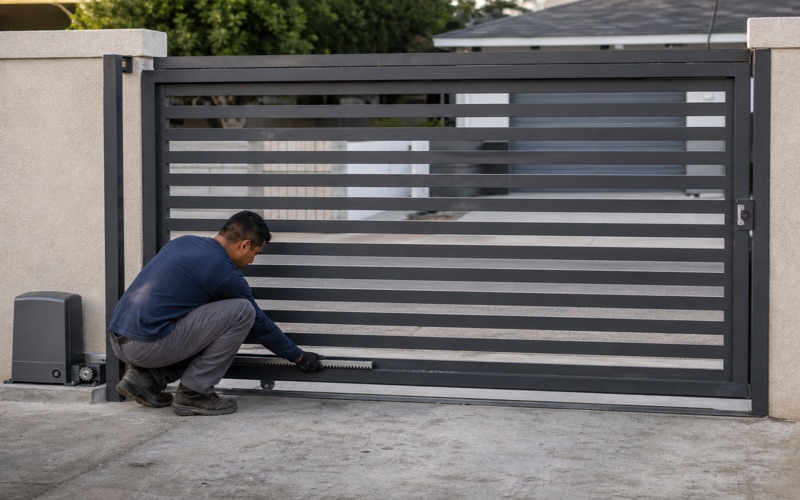
Where the motor runs and the leaf stays put, the drive has disconnected somewhere: a sheared key, a worn gear rack, a slipped chain, or a manual release left disengaged after an outage. On a heavily cycled entrance the gear rack is the usual answer, and it wears fastest where the leaf is not running true. Correcting the alignment rather than replacing the rack again is what stops it recurring on the same schedule.
Wear Parts and Response
Rollers, guide rollers, truck bearings and hinges are consumables on an entrance that cycles this hard, and they announce themselves before failing through a change in running noise or a leaf that dips at one point in its travel. We keep the common parts to hand and would rather attend a site periodically than be called when a gate has already stopped, because on premises where the entrance is operational equipment the cost of a failure is never just the repair.
Settings Recorded, Safety Never Bypassed
Every visit ends with the entrapment protection tested rather than disconnected, and with the operator’s force, travel limits and reversing behaviour set and written down. Bypassing a photo eye to get a gate running is the most common thing we find already done on arrival, and it removes precisely the protection the standard exists to provide. The written settings are what let the next technician tell drift from failure.
- 20+ Years in the Trade
- Free On-Site Measure
- Permit Work Handled